
| Index | Albuquerque | New Mexico | National |
| Cost of living | 101 | 94 | 100 |
| Groceries | 97 | 98 | 100 |
| Health care | 98 | 98 | 100 |
| Housing | 109 | 85 | 100 |
| Transportation | 98 | 98 | 100 |
| Utilities | 95 | 97 | 100 |
| Lifestyle & Entertainment | 97 | 96 | 100 |
| Household Items | 98 | 98 | 100 |
| Education & Childcare | 101 | 96 | 100 |

The cost of living in Albuquerque affects the quality of life one can afford in this new location. It allows people to assess whether they can maintain their preferred lifestyle, including housing, leisure activities and dining options. Your total monthly expenditures can varry depending on the area, as well as many other factors. The cost of living in Albuquerque is 101, which is 1% higher than the national average. Knowledge of the cost of living can help individuals make informed decisions about retirement savings, investments, and financial goals.
The cost of living in Albuquerque closely mirrors the national average in comparison to other cities nationwide. Essential items such as groceries, houshold expenses, health care and utilities are priced at a level consistent with similar urban areas. This means that residents of Albuquerque can anticipate that their daily expenses will remain reasonably in line with those of an average city, contributing to a manageable cost of living.
The real experts on a city are its residents. That's why we reached out to 40 locals to get their views on the cost of living in Albuquerque. We surveyed the residents and asked them if they felt like prices were affordable or out of reach. The results were as follows. 43% found it budget-friendly with decreasing prices, while 58% said it's simply not affordable as prices have continued to rise.
Is Albuquerque an affordable place to live? It's a good question and one that you might want to ask when considering any new city, as affordability can play a huge role in the decision making process. The cost of living index (which we covered above), as well as housing costs and income levels play a vital role in determining the affordability of an area. The median home price in Albuquerque is 15.4% higher than the national average, while the average monthly rent prices are 7.3% lower than average. The affordability of any location can also be influenced by median income levels. Albuquerque has a median household income of $80,299, which is 1.3% lower than the national average.
Healthcare: Healthcare expenditures and insurance premium rates can vary significantly, contingent upon the particular city or state. Factors such as the accessibility of healthcare facilities, out-of-pocket expenses for doctor's appointments, dental care charges, prescription medication costs, and expenses related to specialized medical care can all have an impact on the overall cost of living. In Albuquerque, healthcare costs are 2.1% lower than the national average.
Taxes: Locations with elevated tax rates, encompassing both sales and income taxes, can be a factor in driving up the cost of living. When you're paying more in taxes for everyday household expenses, it naturally translates into higher expenses. Similarly, a higher income tax rate can also contribute to an overall higher cost of living. In Albuquerque, the standard sales tax rate starts at 5%, and the income tax rates commence at 1.7%.
Transportation: In areas where public transportation is scarce or unavailable, residents often find themselves compelled to own and upkeep vehicles, thereby increasing the overall cost of living. Monthly expenses encompass fuel, insurance, routine maintenance and potentially lease or financing payments. In Albuquerque, the transportation index is 1.8% lower than the national average.
The cost of living data for Albuquerque shown above is based on a U.S. average baseline score of 100, making it easier to compare how far your dollar may go from one city to another. Housing uses U.S. Census home price and rental data, while all remaining values are AI-assisted estimates informed by regional pricing, climate, transportation dynamics, and local economic factors. These scores are best used for directional comparisons between cities.

| Cost of living index | |
| Groceries index | |
| Health care index | |
| Housing index | |
| Transportation index | |
| Utilities index | |
| Lifestyle index | |
| Household index | |
| Educare index |
| Median Income | Per Year | Per Month | Max Budget (28% DTI) | Max Budget (36% DTI) |
| Owners | $104,555 | $8,713 | $2,439 | $3,137 |
| Renters | $50,466 | $4,206 | $1,177 | $1,514 |
| State | General Sales Tax | With Max Surtax |
| New Mexico | 5% | 8.688% |
| State | Income Tax (Low) | Income Tax (High) |
| New Mexico | 1.7% | 5.9% |
| City | Population | Cost of Living Index | National Avg. |
| San Antonito CDP (Socorro County), NM | 34 | 98 | 2.3% |
| Pajarito Mesa, NM | 316 | 76 | 24.3% |
| Isleta Village Proper, NM | 502 | 83 | 17.3% |
| Monterey Park, NM | 1,135 | 85 | 15.0% |
| Indian Hills, NM | 839 | 91 | 8.6% |
| Albuquerque, NM | 579,406 | 101 | 1.0% |
| City | Population | Cost of Living Index | National Avg. |
| Tucson, AZ | 564,632 | 100 | 0.3% |
| Surrey, BC | 560,150 | n/a | |
| Milwaukee, WI | 605,531 | 93 | 7.2% |
| Québec, QC | 548,244 | n/a | |
| Fresno, CA | 543,090 | 123 | 23.1% |
| Albuquerque, NM | 579,406 | 101 | 1.0% |

 Here are the best places to live in New Mexico
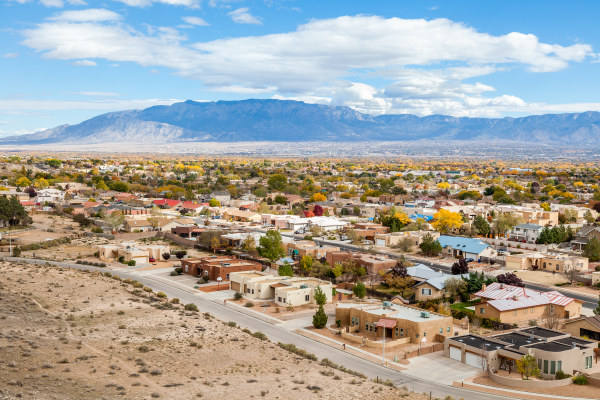 See the best places to live in Albuquerque
 Check out the 10 safest cities in New Mexico
 Check out the 10 most dangerous cities in New Mexico