
| Statistic | Reportedincidents | /100k people | Spokane/100k people | Washington/100k people | National/100k people |
| Total crime | 12,660 | n/a (estimate) | 5,516 | 2,793 | 2,119 |
| Murder | 16 | n/a | 7.0 | 3.8 | 5.0 |
| Rape | 176 | n/a | 76.7 | 37.8 | 37.5 |
| Robbery | 333 | n/a | 145.1 | 67.5 | 60.6 |
| Assault | 1,024 | n/a | 446.1 | 217.0 | 256.1 |
| Violent crime | 1,549 | n/a (estimate) | 675 | 326 | 359 |
| Burglary | 1,484 | n/a | 646.5 | 398.8 | 229.2 |
| Theft | 8,421 | n/a | 3,668.8 | 1,634.2 | 1,272.1 |
| Vehicle theft | 1,206 | n/a | 525.4 | 433.5 | 258.8 |
| Property crime | 11,111 | n/a (estimate) | 4,841 | 2,467 | 1,760 |

Crime is typically categorized into two main types: violent and property crimes. Violent crimes encompass offenses such as murder, rape, robbery, and assault, while property crimes include burglary, theft, and vehicle theft. Based on the most recent report, the Spokane crime rate is higher than the national average by 160.3%. Specifically, there were 1549 violent crimes in Spokane, equivalent to 675 per 100,000 individuals, higher than the national average by 87.9%. Furthermore, Spokane recorded 11111 property crimes, amounting to 4841 per 100,000 residents, which was higher than the average by 175%.
With a total of 5516 crimes per 100,000 people, the Spokane crime rates stand at 160.27 higher than the national average. Consequently, the area grapples with one of the nation's highest total crime rates. Addressing this challenge is crucial for enhancing the safety and livability in Spokane, making it a priority to reduce crime through community engagement, effective law enforcement, and collaborative efforts to secure a better future for residents and prospective residents.
Spokane faces some of the nation's most elevated property crime rates, recording 4841 incidents per 100,000 people. This places the city among the worst 10% of all U.S. cities that reported crime. Regrettably, the likelihood of falling victim to property crime in Spokane stands at 1 in 21, significantly surpassing the national average. These statistics underscore the imperative need for bolstered community safety measures to mitigate property crimes and enhance the well-being of its residents.
Vehicle thefts across all of America are on the rise and Spokane has one of the highest vehicle theft rates in the country. In the most recent crime report, Spokane reported 1206 vehicle thefts, which equates to 525 stolen vehicles per 100,000 people. This falls in the bottom 10% of all cities, meaning that 90% of cities have better vehicle theft rates. The chance of having your vehicle stolen in Spokane is 1 in 191.
What do the local residents think about crime in Spokane? Well, based on a recent survey of 275 people (conducted by AreaVibes), 28% of Spokane residents said that there was virtually no crime and that they felt safe walking at night. Another 72% of respondents said that there was too much crime in the area and they did not feel safe walking alone at night.
Determining whether Spokane is a place to live may not always yield a simple answer, given the city's varying safety levels across different areas. Nonetheless, comprehending the city's overall crime rate can be a valuable asset. In broad terms, Spokane has an overall crime rate that is 160% higher than the national average. When we take a look at crime on a daily basis, this translates into 34.68 daily occurrences, comprising 4.24 violent crimes and 30.44 property crimes. Scrutinizing these statistics provides a foundation for a more informed assessment of the suitability of Spokane as a potential place to establish residency.
Year-over-year crime rates in Spokane has increased by 4.3% in the last reported crime report. Comparing crime rates from one year to another offers some insight into whether or not Spokane is becoming a safer or more dangerous place to live. Crime rates are categorized by violent and property crime. Year-over-year violent crime has increased by 6.5%, while property crime has increased by 4%. This analysis equips individuals with crucial information for making informed decisions about living in Spokane.
There are more than 27 different neighborhoods in the Spokane area. Depending on their location and other socioeconomic factors, the rate of crime in each neighborhood is vastly different. Areas that are located near the center or downtown core, tend to be more densely populated and typically see higher crime rates. While neighborhoods in the outskirts of the city tend to be less densely populated and have lower unemployment and poverty rates. Some of the safer neighborhoods in Spokane include Lincoln Heights, Manitocannon Hill and North Indian Trail. While Brownes Addition, West Central and East Central have a reported crime rate that is higher than average. This reinforces the need to do a quality check on multiple neighborhoods as their crime rates can be quite different.
The educational level within a community can have an influence on crime rates. Typically, higher levels of education are associated with reduced crime rates, as they offer individuals improved employment prospects and alternatives to engaging in criminal activities. Conversely, lower educational attainment tends to correspond with higher crime rates. In Spokane, 86.7% of residents have achieved at least a high school diploma, which differs from the national average of 83%.
In Spokane, the ratio of police officers and civilians stands at 1.81 per 1,000 residents, contrasting with the national average of 3.25. This discrepancy highlights the potential impact of law enforcement and community policing on crime rates. The strength of their collaboration can serve as a deterrent to criminal behavior, fostering a safer environment. Effective law enforcement leans heavily on community policing strategies that prioritize the cultivation of trust and cooperation between police and residents. It's essential to recognize that the effectiveness of these efforts isn't solely tied to the quantity of officers but also hinges on the quality of their engagement with the community.
In areas where housing affordability is an issue, crime can become a significant concern. Some individuals and families may be forced to live in overcrowded or substandard housing conditions, which can increase stress and potentially contribute to domestic disputes and related crimes. The median home price in Spokane is $359,861, compared to a national average of $326,622.

| Item | Spokane | Washington | National |
| Law enforcement employees (officers & civilians) | 384 | 8,169 | 558,732 |
| Police officers & civilians /1000 residents | 1.8 | 2.2 | 3.3 |
| State | Total offenders | Washington /100K | National /100K |
| Washington | 6,688 | 107 | 266 |
| City | Population | Violent crime/100k people | Property crime/100k people | Total crime/100k people |
| Millwood, WA | 1,787 | 131 | 992 | 1,123 |
| Green Bluff, WA | 375 | 132 | 996 | 1,128 |
| Cheney, WA | 12,816 | 371 | 1,670 | 2,041 |
| Medical Lake, WA | 5,075 | 255 | 1,931 | 2,187 |
| Mead, WA | 7,244 | 272 | 2,058 | 2,330 |
| Country Homes, WA | 6,038 | 304 | 2,297 | 2,600 |
| Town and Country, WA | 5,549 | 311 | 2,350 | 2,661 |
| Spokane, WA | 223,638 | 675 | 4,841 | 5,516 |
| City | Population | Violent crime/100k people | Property crime/100k people | Total crime/100k people |
| Tacoma, WA | 223,137 | 1,063 | 5,604 | 6,667 |
| Spring Valley, NV | 224,434 | 353 | 1,928 | 2,281 |
| Modesto, CA | 222,619 | 656 | 2,415 | 3,070 |
| Des Moines, IA | 221,968 | 703 | 3,126 | 3,829 |
| San Bernardino, CA | 221,910 | 897 | 2,898 | 3,795 |
| Spokane, WA | 223,638 | 675 | 4,841 | 5,516 |

 Here are the best places to live in Washington
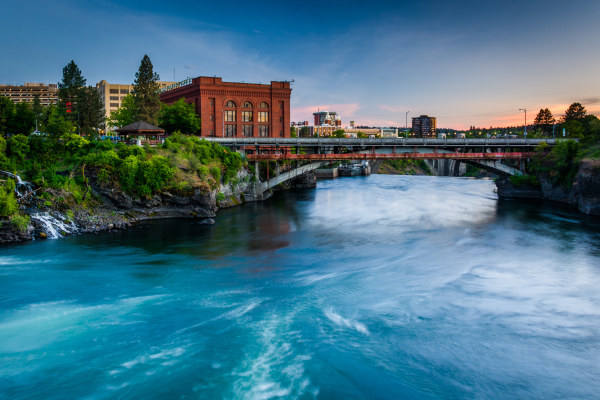 See the best places to live in Spokane
 Safest States In The US
 These are the largest cities in Washington