
| Statistic | Reportedincidents | /100k people | Hometown/100k people | Illinois/100k people | National/100k people |
| Total crime | 71 | n/a (estimate) | 1,742 | 2,004 | 2,119 |
| Murder | 0 | n/a | 0.0 | 5.8 | 5.0 |
| Rape | 3 | n/a | 73.6 | 46.9 | 37.5 |
| Robbery | 1 | n/a | 24.5 | 90.2 | 60.6 |
| Assault | 5 | n/a | 122.7 | 146.3 | 256.1 |
| Violent crime | 9 | n/a (estimate) | 221 | 289 | 359 |
| Burglary | 6 | n/a | 147.2 | 290.5 | 229.2 |
| Theft | 51 | n/a | 1,251.2 | 1,134.4 | 1,272.1 |
| Vehicle theft | 5 | n/a | 122.7 | 290.4 | 258.8 |
| Property crime | 62 | n/a (estimate) | 1,521 | 1,715 | 1,760 |
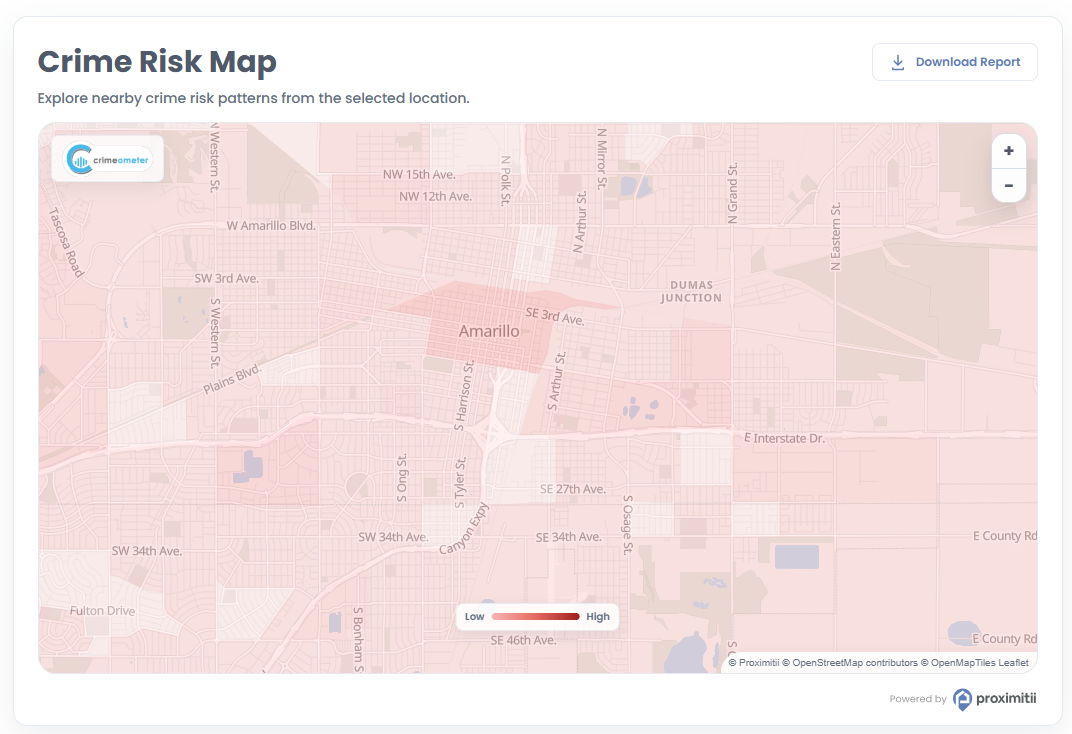

The Hometown crime rates are 17.8% lower than the national average. There are two main categories of crime - violent crime and property crime. Violent crime consists of murder, rape, robbery and assault, while property crimes include burglary, theft and vehicle theft. There were a total of 9 violent crimes in Hometown (221 per 100,000 people), which is 38.5% lower than the national average and there were a total of 62 property crimes (1521 per 100,000 residents) which is 13.6% lower than average.
In the most recently reported crime year, Hometown registered zero reported homicides. This statistic not only designates the area as an exemplar of security but also emanates a profound sense of safety within its community. A minimal incidence of severe violent crime not only fosters a strong sense of well-being among residents but also sets a commendable standard for other regions aiming to cultivate similarly safe surroundings.
To determine if Hometown is a safe place to live, let's take a look at the overall crime rate of the area, as well as the number of daily crimes. Hometown has a total crime rate that is 18% lower than the national average per 100,000 residents. This results in a total of 0.19 daily crimes (0.02 violent daily crimes and 0.17 daily property crimes) in Hometown.
Year-over-year crime data allows residents and potential residents to assess the crime in Hometown. A decrease in crime rates may indicate improving safety, while an increase could raise concerns. The year-over-year crime rate in Hometown has increased by 294.4%. Violent crimes have increased by 200%, while property crimes have increased by 313.3%. By comparing crime rates from one year to the next, authorities and communities can identify trends and patterns in criminal activity. This helps in understanding whether crime is increasing, decreasing, or remaining stable over time.
Highly populated regions typically encompass expansive urban hubs teeming with diverse economic prospects. Within these areas, income inequality can be exacerbated, giving rise to enclaves of poverty amid affluence. Communities marked by economic disparities may contend with heightened property crimes, and in certain instances, violent crimes. Conversely, regions characterized by low population density often exhibit lower Hometown crime rates. For instance, in Hometown, the population density stands at 9083.4 people per square mile, diverging from the national average of 90.6 people per square mile.
The effectiveness of law enforcement and community policing initiatives can influence crime rates. A strong and collaborative relationship between the police and the community can deter criminal activity and improve safety. In Hometown, there are 1.14 police officers and civilians per 1,000 residents, compared to the national average of 3.25. The effectiveness of law enforcement often depends on community policing strategies that emphasize building trust and cooperation between the police and the community. It's not just about the number of officers but also how they engage with the community.
The median home price in Hometown is $220,011, compared to the national average of $326,622. High housing costs can lead to financial stress for residents. When individuals struggle to make ends meet due to expensive housing, they may be more inclined to engage in criminal activities to address their financial difficulties, such as theft or fraud. Communities with stable housing environments tend to foster stronger social bonds and community engagement. This can lead to increased vigilance and cooperation among residents, which can deter criminal behavior.

| Item | Hometown | Illinois | National |
| Law enforcement employees (officers & civilians) | 5 | 30,690 | 558,732 |
| Police officers & civilians /1000 residents | 1.1 | 2.6 | 3.3 |
| State | Total offenders | Illinois /100K | National /100K |
| Illinois | 32,213 | 263 | 266 |
| City | Population | Violent crime/100k people | Property crime/100k people | Total crime/100k people |
| Stone Park, IL | 4,997 | 92 | 138 | 230 |
| Western Springs, IL | 13,775 | 8 | 273 | 280 |
| Homer Glen, IL | 25,242 | 16 | 277 | 293 |
| Indian Head Park, IL | 3,873 | 0 | 312 | 312 |
| Willow Springs, IL | 5,786 | 0 | 390 | 390 |
| Clarendon Hills, IL | 9,104 | 0 | 434 | 434 |
| Palos Hills, IL | 17,664 | 68 | 411 | 479 |
| Hometown, IL | 4,350 | 221 | 1,521 | 1,742 |
| City | Population | Violent crime/100k people | Property crime/100k people | Total crime/100k people |
| Wayland, MI | 4,349 | 282 | 897 | 1,180 |
| Hokes Bluff, AL | 4,351 | 85 | 403 | 487 |
| Trenton, TN | 4,348 | 513 | 1,759 | 2,272 |
| Chatsworth, GA | 4,352 | 123 | 533 | 655 |
| Country Lake Estates, NJ | 4,348 | 178 | 1,163 | 1,340 |
| Hometown, IL | 4,350 | 221 | 1,521 | 1,742 |

 Here are the best places to live in Illinois
 See the best places to live in Hometown
 These are the largest cities in Illinois
 Most Dangerous States In The US