
| Statistic | Reportedincidents | /100k people | Greensboro/100k people | North Carolina/100k people | National/100k people |
| Total crime | 13,106 | n/a (estimate) | 4,307 | 2,344 | 2,119 |
| Murder | 43 | n/a | 14.1 | 7.5 | 5.0 |
| Rape | 80 | n/a | 26.3 | 28.0 | 37.5 |
| Robbery | 528 | n/a | 173.5 | 50.2 | 60.6 |
| Assault | 2,160 | n/a | 709.8 | 290.1 | 256.1 |
| Violent crime | 2,811 | n/a (estimate) | 924 | 376 | 359 |
| Burglary | 1,468 | n/a | 482.4 | 323.9 | 229.2 |
| Theft | 7,024 | n/a | 2,308.2 | 1,390.2 | 1,272.1 |
| Vehicle theft | 1,803 | n/a | 592.5 | 254.1 | 258.8 |
| Property crime | 10,295 | n/a (estimate) | 3,383 | 1,968 | 1,760 |

The Greensboro crime rates are 103.2% higher than the national average. There are two main categories of crime - violent crime and property crime. Violent crime consists of murder, rape, robbery and assault, while property crimes include burglary, theft and vehicle theft. There were a total of 2811 violent crimes in Greensboro (924 per 100,000 people), which is 157.2% higher than the national average and there were a total of 10295 property crimes (3383 per 100,000 residents) which is 92.2% higher than average.
Greensboro has a crime rate of 4307 per 100,000 people, which surpasses the national average by 103.23%, leading to one of the highest total crime rates in the United States. Addressing this issue is vital for improving overall safety and desirability of Greensboro. Efforts to reduce crime through community engagement, effective law enforcement, and collaborative initiatives are essential to create a more secure and appealing environment for residents and prospective newcomers alike.
Greensboro has gained notoriety as one of the most dangerous cities in the United States, given its alarming violent crime rate of 924 crimes per 100,000 people. In fact, Greensboro falls within the lowest 10% among cities reporting violent crimes last year, resulting in a concerning 1 in 109 likelihood of experiencing a violent crime. It's important to note that safety levels may vary across different areas within the city, and this statistic doesn't necessarily reflect the entire city's situation regarding violent crime.
Although murder rates are essentially half of what they used to be 30+ years ago, some cities still struggle with higher rates than others. Greensboro is one of those cities. In the last reported crime year, there were a total of 43 murders in Greensboro, which equates to 14 murders per 100,000 people. This results in Greensboro being a very dangerous place to live.
The occurrence of vehicle thefts has been increasing nationwide, and Greensboro faces one of the highest vehicle theft rates in the United States. In the latest reported crime year, there were a reported 1803 vehicle thefts, translating to 592 stolen vehicles per 100,000 residents. This places Greensboro in the bottom 10% among all cities, signifying that 90% of cities have less stolen vehicles. The likelihood of experiencing a vehicle theft is 1 in 169.
What is the prevailing sentiment among Greensboro residents regarding the state of crime? A comprehensive survey conducted by AreaVibes, involving 189 respondents, sheds light on this matter. The results were as follows: 40% of Greensboro residents expressed a notable sense of security, asserting that crime was virtually non-existent in their community, and they felt at ease strolling the streets after dark. While, 60% of those surveyed held a contrasting viewpoint, perceiving a higher incidence of crime, leading them to feel apprehensive about walking alone at night.
To determine if Greensboro is a safe place to live, let's take a look at the overall crime rate of the area, as well as the number of daily crimes. Greensboro has a total crime rate that is 103% higher than the national average per 100,000 residents. This results in a total of 35.91 daily crimes (7.7 violent daily crimes and 28.21 daily property crimes) in Greensboro.
Examining year-over-year crime data provides insights into short-term trends with regards to the crime activity in Greensboro. This analysis involves comparing crime rates from one year to the next, enabling the identification of patterns and fluctuations in crime. Such information proves invaluable to residents seeking to make well-informed decisions about their choice of residence. In the most recent year, compared to the previous one, total crime in Greensboro has decreased by 0.9%. Specifically, violent crime has increased by 6.9%, while property crime has decreased by 2.8%. This data empowers individuals with a clearer understanding of the evolving safety landscape in Greensboro.
Greensboro has a population density of 2369.4 people per square mile, contrasting with the national average of 90.6 people per square mile. High population density cities are often large urban hubs teeming with diverse economic opportunities. Within these environments, income disparities can become pronounced, leading to higher poverty levels. This economic divide may contribute to an uptick in property crimes and, occasionally, violent crimes. In contrast, areas characterized by low population density typically exhibit lower Greensboro crime rates.
In Greensboro, 86.4% of residents have successfully graduated from high school, whereas the national average stands at 83%. The educational makeup of any city can exert a significant influence on crime rates. Typically, higher levels of educational attainment are associated with reduced crime rates, as they furnish individuals with improved employment prospects and viable alternatives to engaging in criminal activities. Conversely, communities characterized by lower educational achievement often grapple with higher crime rates, as limited opportunities may drive individuals towards criminal behavior.
The effectiveness of law enforcement and community policing initiatives can influence crime rates. A strong and collaborative relationship between the police and the community can deter criminal activity and improve safety. In Greensboro, there are 2.74 police officers and civilians per 1,000 residents, compared to the national average of 3.25. The effectiveness of law enforcement often depends on community policing strategies that emphasize building trust and cooperation between the police and the community. It's not just about the number of officers but also how they engage with the community.

| Item | Greensboro | North Carolina | National |
| Law enforcement employees (officers & civilians) | 757 | 14,511 | 558,732 |
| Police officers & civilians /1000 residents | 2.7 | 4.8 | 3.3 |
| State | Total offenders | North Carolina /100K | National /100K |
| North Carolina | 26,293 | 320 | 266 |
| City | Population | Violent crime/100k people | Property crime/100k people | Total crime/100k people |
| Jamestown, NC | 4,388 | 98 | 511 | 609 |
| Forest Oaks, NC | 4,258 | 98 | 511 | 609 |
| Oak Ridge, NC | 7,138 | 122 | 640 | 762 |
| Summerfield, NC | 11,715 | 143 | 750 | 893 |
| Stokesdale, NC | 5,586 | 154 | 806 | 960 |
| Gibsonville, NC | 7,425 | 177 | 925 | 1,102 |
| Archdale, NC | 12,179 | 107 | 1,120 | 1,227 |
| Greensboro, NC | 304,481 | 924 | 3,383 | 4,307 |
| City | Population | Violent crime/100k people | Property crime/100k people | Total crime/100k people |
| Anchorage, AK | 302,697 | 1,015 | 2,766 | 3,781 |
| Cincinnati, OH | 309,429 | 846 | 3,829 | 4,675 |
| Pittsburgh, PA | 310,293 | 427 | 2,280 | 2,707 |
| Plano, TX | 297,929 | 152 | 1,466 | 1,618 |
| Orlando, FL | 294,679 | 215 | 1,144 | 1,359 |
| Greensboro, NC | 304,481 | 924 | 3,383 | 4,307 |

 Here are the best places to live in North Carolina
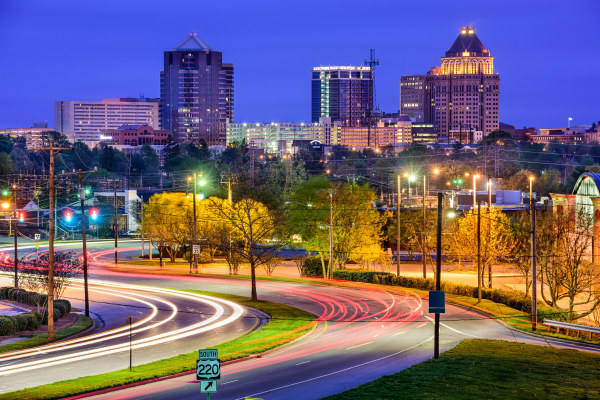 See the best places to live in Greensboro
 Most Dangerous States In The US
 These are the largest cities in North Carolina