
| Index | Evanston | Illinois | National |
| Cost of living | 131 | 98 | 100 |
| Groceries | 98 | 100 | 100 |
| Health care | 97 | 100 | 100 |
| Housing | 205 | 95 | 100 |
| Transportation | 100 | 101 | 100 |
| Utilities | 102 | 99 | 100 |
| Lifestyle & Entertainment | 103 | 100 | 100 |
| Household Items | 101 | 100 | 100 |
| Education & Childcare | 101 | 100 | 100 |

Getting a feel for the cost of living in Evanston is essential for anyone planning to relocate, as it empowers them to make informed financial decisions, secure a comfortable lifestyle and maintain financial stability in their new environment. The cost of living in Evanston is 131, which is 31% higher than the national average. Relocating individuals may need to adjust their savings and investment strategies based on the cost of living in the new location. It influences decisions about retirement planning, investments and financial goals.
If you value affordability in your search for a new place to live, Evanston may not be the most suitable option, as it stands out as one of the priciest areas in the entire United States. Only a small fraction of regions have a cost of living that is more than 20% higher than the national average, and regrettably, Evanston falls into this category, which may not align with your desire for an affordable place to call home.
Housing costs are a major factor in the Evanston cost of living index, and they often eat up a big chunk of your take-home pay. Unfortunately, in this area, housing expenses for both homeownership and rentals were 105% higher than what's typical in an average city. That includes the prices of homes and rents, as well as mortgage rates and insurance.
The most insightful perspective on a city comes from its residents. We recently surveyed 7 locals to gauge their perception of the cost of living in Evanston. The feedback revealed that 71% of respondents found the cost of living to be reasonable, with prices on the decline, while 29% regarded it as notably expensive with prices that continue to rise.
Wondering if Evanston is affordable? It's a question that often comes up when you're thinking about a new city since affordability can really shape your decisions. The cost of living index (covered earlier), housing expenses and income levels all play a part in the affordability equation. In Evanston, for example, the median home price is 127.4% higher than what folks pay nationally, and monthly rent is 52.6% higher than the usual rates. Plus, income levels matter too, with Evanston boasting a median household income of $124,314, which is 52.8% higher than the national average.
Utilities: Similar to the prices of any goods or services, utility expenses can fluctuate widely, contingent on variables such as climate, available energy sources, geographical location and state regulations. Costs associated with electricity, water, heating, and waste disposal can differ in magnitude, depending on the specific city or state. In Evanston, the utilities index registers at 1.6% higher than the national average.
Subsidies: Some cities and states may extend government subsidies or aid programs aimed at reducing the cost of living for their residents. These initiatives encompass diverse forms of support, including Medicare, Medicaid, housing subsidies, low-income home energy assistance programs, school lunch programs, supplemental nutrition assistance programs, student loans, electric vehicle tax credits, affordable care act subsidies and farm subsidies. Regions with limited subsidy provisions may witness an increase in their overall cost of living.
Taxes: Cities that impose higher taxes, including sales and income taxes, can contribute to an escalated cost of living. The added expense of taxes on everyday goods like clothing and food naturally results in higher overall costs. Similarly, a higher income tax rate can further elevate the cost of living. In Evanston, the general sales tax rate starts at 6.25%, and income tax rates begin at 4.95%.
The Evanston cost of living data above is designed around a U.S. average baseline of 100, allowing for easy comparisons of relative living costs. Housing incorporates U.S. Census home price and rental data, while all other figures are AI-assisted estimates that account for regional price trends, climate, transportation dynamics, and common everyday expenses. These values are best used as directional city-to-city comparisons.

| Cost of living index | |
| Groceries index | |
| Health care index | |
| Housing index | |
| Transportation index | |
| Utilities index | |
| Lifestyle index | |
| Household index | |
| Educare index |
| Median Income | Per Year | Per Month | Max Budget (28% DTI) | Max Budget (36% DTI) |
| Owners | $189,769 | $15,814 | $4,428 | $5,694 |
| Renters | $76,359 | $6,363 | $1,782 | $2,291 |
| State | General Sales Tax | With Max Surtax |
| Illinois | 6.25% | 10.25% |
| State | Income Tax (Low) | Income Tax (High) |
| Illinois | 4.95% | 4.95% |
| City | Population | Cost of Living Index | National Avg. |
| Maywood, IL | 23,986 | 96 | 3.6% |
| Broadview, IL | 7,841 | 99 | 0.9% |
| Bellwood, IL | 19,287 | 99 | 1.0% |
| Cicero, IL | 84,320 | 100 | 0.3% |
| Berkeley, IL | 5,266 | 100 | 0.2% |
| Evanston, IL | 75,477 | 131 | 31.4% |
| City | Population | Cost of Living Index | National Avg. |
| Flagstaff, AZ | 75,433 | 126 | 25.9% |
| Bismarck, ND | 75,566 | 106 | 5.6% |
| South Jordan, UT | 75,278 | 136 | 36.0% |
| Apple Valley, CA | 75,217 | 123 | 22.8% |
| Lafayette, IN | 75,191 | 89 | 11.4% |
| Evanston, IL | 75,477 | 131 | 31.4% |

 Here are the best places to live in Illinois
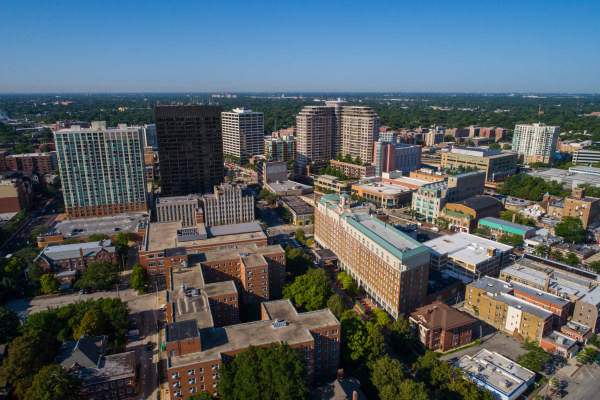 See the best places to live in Evanston
 These are the largest cities in Illinois
 These are the 10 cheapest cities in Illinois