
| Index | Boise | Idaho | National |
| Cost of living | 116 | 98 | 100 |
| Groceries | 104 | 102 | 100 |
| Health care | 103 | 101 | 100 |
| Housing | 143 | 90 | 100 |
| Transportation | 105 | 103 | 100 |
| Utilities | 99 | 101 | 100 |
| Lifestyle & Entertainment | 109 | 105 | 100 |
| Household Items | 100 | 101 | 100 |
| Education & Childcare | 107 | 101 | 100 |

Are you thinking about relocating, but curious about the potential cost of living in Boise? Is it more expensive or more affordable than average? Based on the most recent report, the cost of living in Boise stands at 116, making it 16% higher than the national average. The cost of living directly affects the affordability of one's desired lifestyle. Knowing the cost of housing, transportation, groceries and other essentials in the new area allows people to gauge whether they can maintain their preferred standard of living.
Housing costs make up a big chunk of the cost of living in Boise, and they usually eat into a large part of your take-home pay. Unfortunately, in this area, both buying a home and renting one costs 43.3% more than the average city. This includes stuff like home prices, rent, mortgage rates, and insurance.
When it comes to knowing a city, its residents are the experts. We conducted a survey with 51 locals to understand their opinions on the cost of living in Boise. The results indicated that 39% found it reasonably priced with decreasing prices of goods and services, while 61% viewed it as quite expensive, with increasing prices.
Is Boise an affordable place to live? That's a valid question to ask when you're thinking about moving to a new city. After all, how much it costs to live somewhere can be a huge factor in your decision. Affordability can be broken down into 3 common categories. The cost of living index (we talked about it earlier), housing expenses and income levels all play a big role in figuring out if a place is affordable. For instance, in Boise, the median home price is 59.4% higher than what most folks pay across the country, and monthly rent prices are 5.5% higher than the usual rates. Income levels in Boise come in at $93,280, which is 14.7% higher than the national average.
Utilities: Much like any other costs, utility expenses can exhibit considerable variations, influenced by factors such as climate, available energy sources, geographic location and state regulations. The costs associated with electricity, water, heating, and waste disposal can vary significantly depending on the city or state in question. In Boise, the utilities index stands at 0.9% lower than the national average.
Groceries: Grocery costs have continued to increase significantly over the last 2-3 years. In some markets the cost of food has gone up by more than 20% in that period. While other markets have managed to see only a moderate uptick. These food costs can have a major impact on the cost of living in any area. In Boise, the groceries index is 4.3% higher than the national average.
Taxes: Cities that impose higher taxes, including sales and income taxes, can contribute to an escalated cost of living. The added expense of taxes on everyday goods like clothing and food naturally results in higher overall costs. Similarly, a higher income tax rate can further elevate the cost of living. In Boise, the general sales tax rate starts at 6%, and income tax rates begin at 5.8%.
The Boise cost of living data displayed above uses a U.S. average baseline of 100 to provide a practical way to compare living expenses across cities. Housing estimates incorporate U.S. Census home price and rental data, while all other values are generated using AI-assisted models based on everyday expense expectations, regional pricing trends, climate, transportation patterns, and local economic conditions. These values are designed for directional city-to-city comparisons.

| Cost of living index | |
| Groceries index | |
| Health care index | |
| Housing index | |
| Transportation index | |
| Utilities index | |
| Lifestyle index | |
| Household index | |
| Educare index |
| Median Income | Per Year | Per Month | Max Budget (28% DTI) | Max Budget (36% DTI) |
| Owners | $120,121 | $10,010 | $2,803 | $3,604 |
| Renters | $63,716 | $5,310 | $1,487 | $1,912 |
| State | General Sales Tax | With Max Surtax |
| Idaho | 6% | 8.5% |
| State | Income Tax (Low) | Income Tax (High) |
| Idaho | 5.8% | 5.8% |
| City | Population | Cost of Living Index | National Avg. |
| Garden City, ID | 12,216 | 109 | 8.7% |
| Kuna, ID | 21,530 | 111 | 11.4% |
| Star, ID | 10,093 | 116 | 16.5% |
| Robie Creek, ID | 1,434 | 117 | 17.4% |
| Meridian, ID | 110,487 | 119 | 18.9% |
| Boise, ID | 234,372 | 116 | 15.7% |
| City | Population | Cost of Living Index | National Avg. |
| Richmond, VA | 237,217 | 112 | 12.3% |
| Windsor, ON | 230,583 | n/a | |
| Baton Rouge, LA | 229,041 | 99 | 1.0% |
| Regina, SK | 241,465 | n/a | |
| Hialeah, FL | 241,985 | 116 | 16.1% |
| Boise, ID | 234,372 | 116 | 15.7% |

 Here are the best places to live in Idaho
 Most Dangerous States In The US
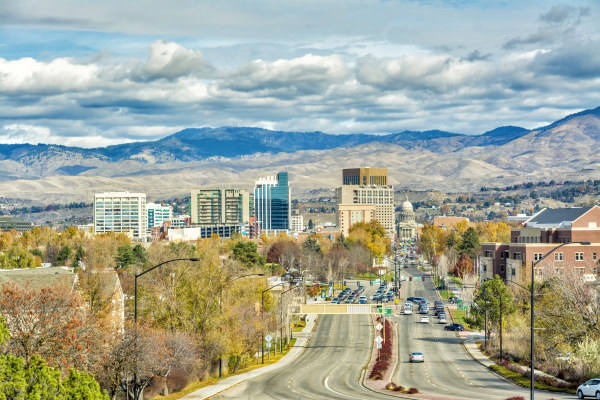 See the best places to live in Boise
 Safest Cities In The US