
| Statistic | Reportedincidents | /100k people | Austin/100k people | Texas/100k people | National/100k people |
| Total crime | 36,517 | n/a (estimate) | 3,709 | 2,430 | 2,119 |
| Murder | 65 | n/a | 6.6 | 5.2 | 5.0 |
| Rape | 666 | n/a | 67.6 | 50.0 | 37.5 |
| Robbery | 841 | n/a | 85.4 | 63.5 | 60.6 |
| Assault | 3,025 | n/a | 307.2 | 270.7 | 256.1 |
| Violent crime | 4,597 | n/a (estimate) | 467 | 389 | 359 |
| Burglary | 4,383 | n/a | 445.1 | 284.3 | 229.2 |
| Theft | 21,643 | n/a | 2,198.1 | 1,425.6 | 1,272.1 |
| Vehicle theft | 5,894 | n/a | 598.6 | 330.7 | 258.8 |
| Property crime | 31,920 | n/a (estimate) | 3,242 | 2,041 | 1,760 |
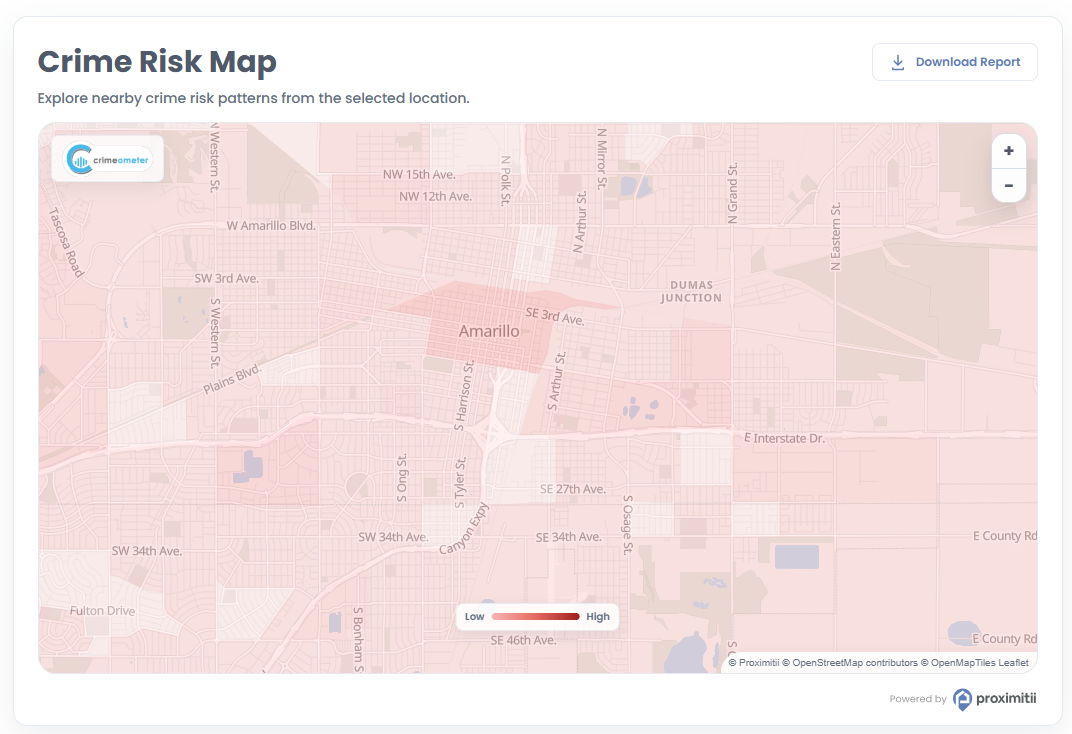
Crime is typically categorized into two main types: violent and property crimes. Violent crimes encompass offenses such as murder, rape, robbery, and assault, while property crimes include burglary, theft, and vehicle theft. Based on the most recent report, the Austin crime rate is higher than the national average by 75%. Specifically, there were 4597 violent crimes in Austin, equivalent to 467 per 100,000 individuals, higher than the national average by 30%. Furthermore, Austin recorded 31920 property crimes, amounting to 3242 per 100,000 residents, which was higher than the average by 84.2%.
With a total of 5894 vehicle thefts last year, Austin has one of the most stolen cars in the country at 599 per 100,000 people. This lands Austin in the bottom 10% of all cities that reported crime and the chance of any vehicle being stolen is one in 168.
What is the prevailing sentiment among Austin residents regarding the state of crime? A comprehensive survey conducted by AreaVibes, involving 262 respondents, sheds light on this matter. The results were as follows: 51% of Austin residents expressed a notable sense of security, asserting that crime was virtually non-existent in their community, and they felt at ease strolling the streets after dark. While, 49% of those surveyed held a contrasting viewpoint, perceiving a higher incidence of crime, leading them to feel apprehensive about walking alone at night.
Determining whether Austin is a place to live may not always yield a simple answer, given the city's varying safety levels across different areas. Nonetheless, comprehending the city's overall crime rate can be a valuable asset. In broad terms, Austin has an overall crime rate that is 75% higher than the national average. When we take a look at crime on a daily basis, this translates into 100.05 daily occurrences, comprising 12.59 violent crimes and 87.45 property crimes. Scrutinizing these statistics provides a foundation for a more informed assessment of the suitability of Austin as a potential place to establish residency.
Examining year-over-year crime data provides insights into short-term trends with regards to the crime activity in Austin. This analysis involves comparing crime rates from one year to the next, enabling the identification of patterns and fluctuations in crime. Such information proves invaluable to residents seeking to make well-informed decisions about their choice of residence. In the most recent year, compared to the previous one, total crime in Austin has decreased by 6.3%. Specifically, violent crime has decreased by 8%, while property crime has decreased by 6.1%. This data empowers individuals with a clearer understanding of the evolving safety landscape in Austin.
There are more than 60 different neighborhoods in the Austin area. Depending on their location and other socioeconomic factors, the rate of crime in each neighborhood is vastly different. Areas that are located near the center or downtown core, tend to be more densely populated and typically see higher crime rates. While neighborhoods in the outskirts of the city tend to be less densely populated and have lower unemployment and poverty rates. Some of the safer neighborhoods in Austin include Downtown, Crestview and University Of Texas. While Riverside, Saint Johns and Mlk have a reported crime rate that is higher than average. This reinforces the need to do a quality check on multiple neighborhoods as their crime rates can be quite different.
The level of education within a community can impact crime rates. Higher educational attainment often correlates with lower crime rates, as it provides individuals with better job opportunities and alternatives to criminal behavior. While lower educational achievement rates tend to lead to higher crime rates. In Austin, 85.3% of people have completed high school, while 83% of people have completed high school nationally.
In Austin, the cost of living is 21.52% higher than the national average. A high cost of living can induce economic stress for locals, especially those with limited financial resources. When people grapple with soaring housing expenses, utility bills, healthcare costs, and other essential necessities, they may be driven towards criminal activities, including theft or fraud, as a means of financial survival. Conversely, cities boasting a lower cost of living may mitigate economic pressures and potentially result in reduced crime rates.
Austin has a ratio of police officers and civilians per 1,000 residents that differs from the national norm, with 2.7 officers and civilians per 1,000 residents, compared to 3.25 nationwide. Crime rates are profoundly influenced by the effectiveness of law enforcement and community policing endeavors. A resilient and cooperative partnership between law enforcement agencies and the community can serve as a deterrent to criminal activities, ultimately enhancing safety. The efficacy of law enforcement extends beyond mere numbers and extends into the realm of community policing strategies, emphasizing the cultivation of trust and collaboration between officers and the community. It is not merely a matter of quantity but the quality of engagement with the community that matters most.

| Item | Austin | Texas | National |
| Law enforcement employees (officers & civilians) | 2,252 | 46,020 | 558,732 |
| Police officers & civilians /1000 residents | 2.7 | 3.0 | 3.3 |
| State | Total offenders | Texas /100K | National /100K |
| Texas | 95,281 | 443 | 266 |
| City | Population | Violent crime/100k people | Property crime/100k people | Total crime/100k people |
| Lost Creek, TX | 1,160 | 55 | 286 | 341 |
| Manchaca, TX | 1,416 | 55 | 286 | 341 |
| Barton Creek, TX | 2,465 | 61 | 320 | 381 |
| The Hills, TX | 2,458 | 61 | 320 | 381 |
| Hudson Bend, TX | 2,525 | 61 | 320 | 381 |
| Shady Hollow, TX | 3,923 | 74 | 389 | 463 |
| Lago Vista, TX | 7,425 | 125 | 434 | 559 |
| Austin, TX | 988,400 | 467 | 3,242 | 3,709 |
| City | Population | Violent crime/100k people | Property crime/100k people | Total crime/100k people |
| Jacksonville, FL | 934,752 | 316 | 1,682 | 1,998 |
| Fort Worth, TX | 926,371 | 458 | 2,700 | 3,158 |
| Columbus, OH | 914,920 | 435 | 2,653 | 3,088 |
| San Jose, CA | 1,062,558 | 607 | 2,588 | 3,195 |
| Charlotte, NC | 903,228 | 733 | 3,705 | 4,439 |
| Austin, TX | 988,400 | 467 | 3,242 | 3,709 |

 Here are the best places to live in Texas
 Check out the 10 most dangerous cities in Texas
 See the best places to live in Austin
 Safest States In The US