
| Statistic | Reportedincidents | /100k people | Paris/100k people | Arkansas/100k people | National/100k people |
| Total crime | 94 | n/a (estimate) | 2,838 | 2,509 | 2,119 |
| Murder | 0 | n/a | 0.0 | 7.3 | 5.0 |
| Rape | 5 | n/a | 151.0 | 69.9 | 37.5 |
| Robbery | 0 | n/a | 0.0 | 38.6 | 60.6 |
| Assault | 21 | n/a | 634.1 | 463.5 | 256.1 |
| Violent crime | 26 | n/a (estimate) | 785 | 579 | 359 |
| Burglary | 18 | n/a | 543.5 | 352.7 | 229.2 |
| Theft | 41 | n/a | 1,237.9 | 1,400.0 | 1,272.1 |
| Vehicle theft | 9 | n/a | 271.7 | 176.8 | 258.8 |
| Property crime | 68 | n/a (estimate) | 2,053 | 1,930 | 1,760 |
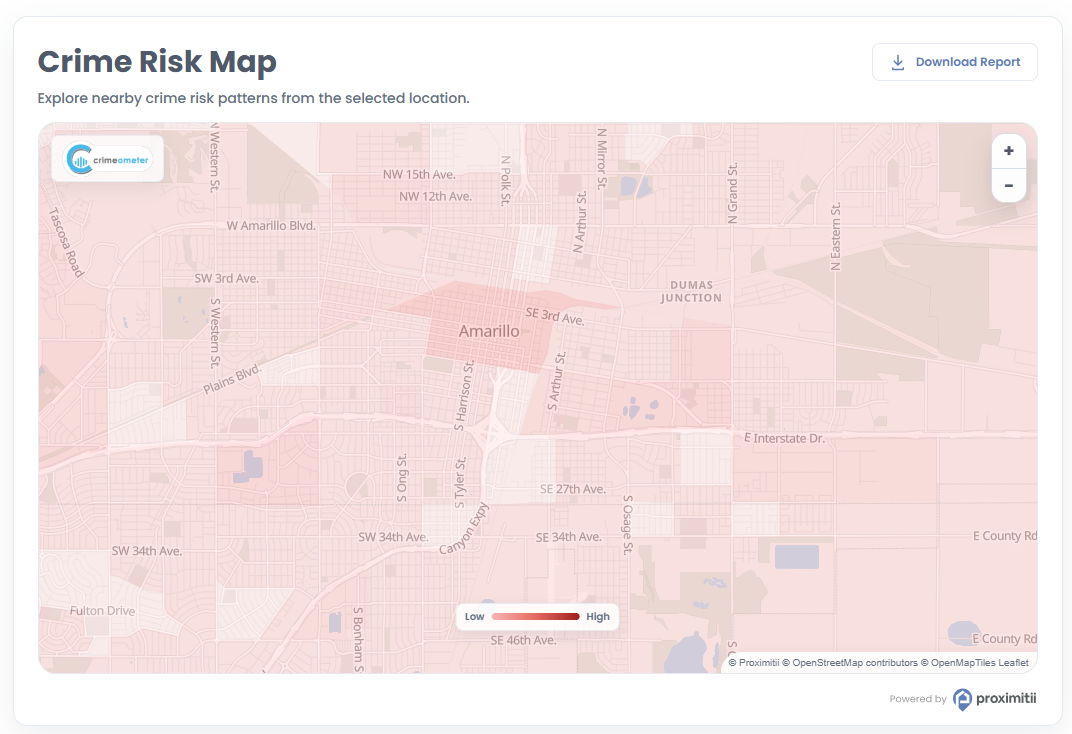
Crime can be categorized into two primary types: violent and property crimes. Violent crimes encompass offenses such as murder, rape, robbery, and assault, whereas property crimes involve acts like burglary, theft, and vehicle theft. The overall crime rate in Paris is 33.9% higher than the national average. Specifically, there were 26 violent crimes reported in Paris, equivalent to 785 per 100,000 residents, which is higher than the national average by 118.6%. Additionally, Paris recorded 68 property crimes, amounting to 2053 per 100,000 people, higher than the national average by 16.7%.
Paris is one of the most dangerous cities in America with a violent crime rate of 785 per 100,000 people - this ranks in the bottom 10% of all U.S. cities that reported crime. Your chance of being a victim of violent crime in Paris is 1 in 128.
In a remarkable testament to the city's commitment to safety, Paris reported a murder rate of 0. This could indicate that it is a very safe place to live, but also serves as an inspiration to other urban areas striving for safer communities. Examining the full crime report will provide a complete overview of all crimes - violent and property.
Before you decide to relocate, it’s always good to ask yourself “Is Paris a safe place to live?” Although the answer might not be that simple, as some areas are safer than others, getting a good feel for the overall rate of crime can definitely be helpful. Overall, the Paris crime rate is 34% higher than the national average. If we break that down daily, that translates into 0.26 crimes per day - 0.07 violent crimes and 0.19 property crimes.
In the most recent crime report, year-over-year crime rates in Paris has decreased by 4.1%. Examining the change in crime rates from one year to the next provides valuable insights into the evolving safety landscape of Paris, aiding residents in assessing whether it is becoming a safer or more dangerous place to live. These crime rates are categorized into two primary groups: violent and property crimes. Year-over-year, violent crime has increased by 73.3%, while property crime has decreased by 18.1%. This comprehensive analysis offers potential residents essential information for making informed decisions about whether or not Paris is a safe place to live.
Paris has a poverty rate that stands at 24.1, in contrast to the national average of 15.1. Historically, a direct correlation has been observed between poverty rates and crime stats. Higher poverty rates have led to higher crime rates, while lower poverty rates have led to a reduction in Paris crime rates. Income disparities and heightened poverty levels can serve as catalysts for elevated or reduced criminal activity, as individuals may or may not turn to illicit means to fulfill their basic needs. This could be one of many factors that may influence crime.
Paris has a population density of 758.2 people per square mile, contrasting with the national average of 90.6 people per square mile. High population density cities are often large urban hubs teeming with diverse economic opportunities. Within these environments, income disparities can become pronounced, leading to higher poverty levels. This economic divide may contribute to an uptick in property crimes and, occasionally, violent crimes. In contrast, areas characterized by low population density typically exhibit lower Paris crime rates.
In Paris, the ratio of police officers and civilians stands at 3.68 per 1,000 residents, contrasting with the national average of 3.25. This discrepancy highlights the potential impact of law enforcement and community policing on crime rates. The strength of their collaboration can serve as a deterrent to criminal behavior, fostering a safer environment. Effective law enforcement leans heavily on community policing strategies that prioritize the cultivation of trust and cooperation between police and residents. It's essential to recognize that the effectiveness of these efforts isn't solely tied to the quantity of officers but also hinges on the quality of their engagement with the community.

| Item | Paris | Arkansas | National |
| Law enforcement employees (officers & civilians) | 13 | 5,164 | 558,732 |
| Police officers & civilians /1000 residents | 3.7 | 2.9 | 3.3 |
| State | Total offenders | Arkansas /100K | National /100K |
| Arkansas | 8,875 | 323 | 266 |
| City | Population | Violent crime/100k people | Property crime/100k people | Total crime/100k people |
| Wiederkehr Village, AR | 21 | 234 | 780 | 1,014 |
| Altus, AR | 933 | 0 | 1,182 | 1,182 |
| Coal Hill, AR | 1,082 | 278 | 928 | 1,206 |
| Morrison Bluff, AR | 50 | 383 | 1,275 | 1,658 |
| Ozark, AR | 3,697 | 666 | 1,331 | 1,997 |
| Caulksville, AR | 176 | 544 | 1,814 | 2,359 |
| Booneville, AR | 3,931 | 471 | 1,961 | 2,431 |
| Paris, AR | 3,506 | 785 | 2,053 | 2,838 |
| City | Population | Violent crime/100k people | Property crime/100k people | Total crime/100k people |
| Three Lakes, WA | 3,506 | 62 | 470 | 532 |
| Hidden Springs, ID | 3,506 | 44 | 140 | 184 |
| Lake Lakengren, OH | 3,506 | 119 | 628 | 747 |
| Riverside, MO | 3,505 | 614 | 4,712 | 5,325 |
| Salunga, PA | 3,505 | 103 | 603 | 707 |
| Paris, AR | 3,506 | 785 | 2,053 | 2,838 |

 Here are the best places to live in Arkansas
 Most Dangerous Cities In The US
 Check out the 10 safest cities in Arkansas
 Safest Cities In The US