
| Statistic | Reportedincidents | /100k people | Jacksonville/100k people | Alabama/100k people | National/100k people |
| Total crime | 336 | n/a (estimate) | 2,268 | 1,925 | 2,119 |
| Murder | 0 | n/a | 0.0 | 8.7 | 5.0 |
| Rape | 6 | n/a | 40.5 | 25.8 | 37.5 |
| Robbery | 1 | n/a | 6.8 | 34.0 | 60.6 |
| Assault | 83 | n/a | 560.4 | 291.4 | 256.1 |
| Violent crime | 90 | n/a (estimate) | 608 | 360 | 359 |
| Burglary | 33 | n/a | 222.8 | 243.5 | 229.2 |
| Theft | 208 | n/a | 1,404.3 | 1,148.5 | 1,272.1 |
| Vehicle theft | 5 | n/a | 33.8 | 173.0 | 258.8 |
| Property crime | 246 | n/a (estimate) | 1,661 | 1,565 | 1,760 |
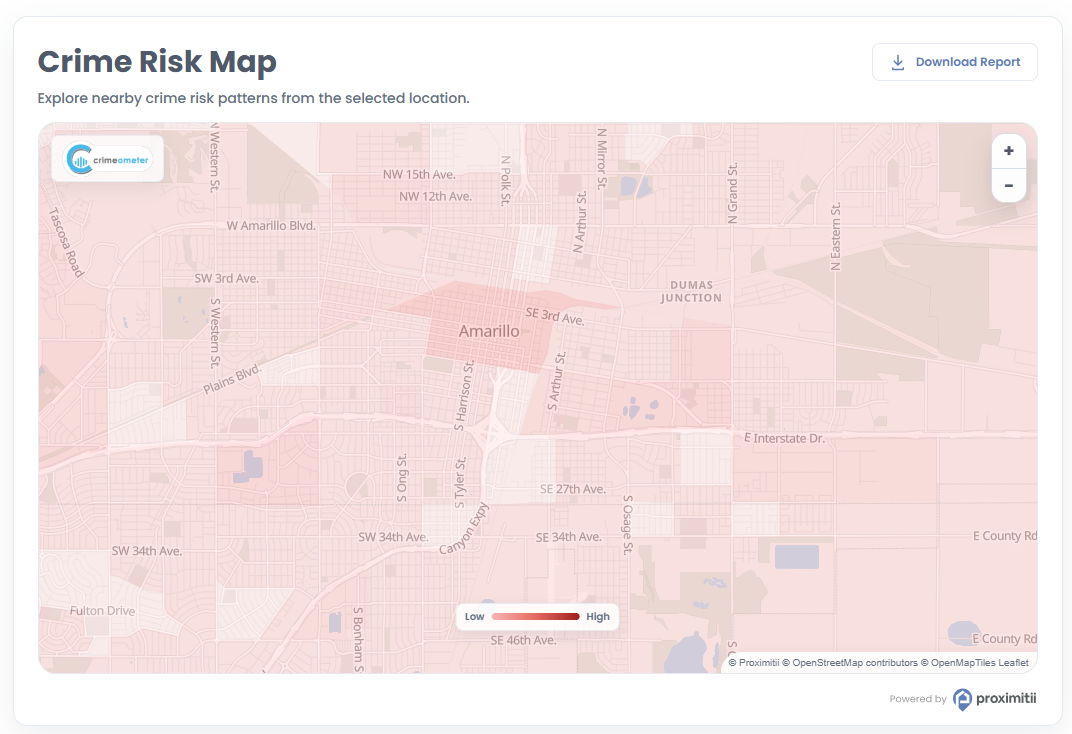

Crime is typically categorized into two main types: violent and property crimes. Violent crimes encompass offenses such as murder, rape, robbery, and assault, while property crimes include burglary, theft, and vehicle theft. Based on the most recent report, the Jacksonville crime rate is higher than the national average by 7%. Specifically, there were 90 violent crimes in Jacksonville, equivalent to 608 per 100,000 individuals, higher than the national average by 69.2%. Furthermore, Jacksonville recorded 246 property crimes, amounting to 1661 per 100,000 residents, which was lower than the average by 5.6%.
When evaluating the Jacksonville crime rate for every 100,000 residents, it positions itself in the middle range among all cities that reported crime. Our examination of total offenses, spanning both violent and property crimes, indicates that the reported Jacksonville crime rates closely correspond to the national average reported by other regions.
Jacksonville showcased a dedication to violent crime safety in its latest reported crime year by achieving a murder rate of 0. This accomplishment could indicate that it is a safe place for residents, but also provides a shining example to other urban areas endeavoring to create safer communities.
The property crime rate per 100,000 people in Jacksonville is very similar to the national average. Jacksonville had a property crime rate of 1661, while the national average was 1760. Based on these numbers, you could expect an average amount of property crime in this area.
What is the prevailing sentiment among Jacksonville residents regarding the state of crime? A comprehensive survey conducted by AreaVibes, involving 20 respondents, sheds light on this matter. The results were as follows: 60% of Jacksonville residents expressed a notable sense of security, asserting that crime was virtually non-existent in their community, and they felt at ease strolling the streets after dark. While, 40% of those surveyed held a contrasting viewpoint, perceiving a higher incidence of crime, leading them to feel apprehensive about walking alone at night.
Is Jacksonville a safe place to live? While the answer may not be straightforward due to variations in safety levels across the city, gaining an understanding of the overall crime rate can prove to be advantageous. In general, Jacksonville has a crime rate that is higher than the national average by 7%. Breaking this down on a daily basis, it translates to 0.92 daily incidents, encompassing 0.25 violent crimes and 0.67 property crimes. Evaluating these statistics can aid in forming a more informed perspective on the safety of Jacksonville as a potential place to call home.
In the most recent crime report, year-over-year crime rates in Jacksonville has decreased by 35.1%. Examining the change in crime rates from one year to the next provides valuable insights into the evolving safety landscape of Jacksonville, aiding residents in assessing whether it is becoming a safer or more dangerous place to live. These crime rates are categorized into two primary groups: violent and property crimes. Year-over-year, violent crime has increased by 5.9%, while property crime has decreased by 43.2%. This comprehensive analysis offers potential residents essential information for making informed decisions about whether or not Jacksonville is a safe place to live.
Jacksonville has a population density of 1204.7 people per square mile, contrasting with the national average of 90.6 people per square mile. High population density cities are often large urban hubs teeming with diverse economic opportunities. Within these environments, income disparities can become pronounced, leading to higher poverty levels. This economic divide may contribute to an uptick in property crimes and, occasionally, violent crimes. In contrast, areas characterized by low population density typically exhibit lower Jacksonville crime rates.
The impact of law enforcement and community policing efforts plays a crucial role in shaping crime rates in any city. A robust and cooperative bond between law enforcement and the community can serve as a deterrent to criminal activities, enhancing overall safety. In Jacksonville, the ratio of police officers and civilians per 1,000 residents stands at 2.63, differing from the national average of 3.25. Effective law enforcement hinges not solely on officer numbers but also on the manner in which they interact and collaborate with the community. Building trust and cooperation are central tenets of community policing, amplifying its influence on crime prevention.
High rental costs can limit economic mobility, making it difficult for individuals to save money, invest in education, or access better job opportunities. This can perpetuate a cycle of poverty and increase the risk of involvement in criminal activities. In summary, high rental costs can create economic challenges, overcrowding, and neighborhood dynamics that may increase the likelihood of certain types of crime, particularly property crimes. In Jacksonville, the average rental rates are $953 per month, compared to the national average of $1,444.

| Item | Jacksonville | Alabama | National |
| Law enforcement employees (officers & civilians) | 33 | 9,968 | 558,732 |
| Police officers & civilians /1000 residents | 2.6 | 4.1 | 3.3 |
| State | Total offenders | Alabama /100K | National /100K |
| Alabama | 10,698 | 231 | 266 |
| City | Population | Violent crime/100k people | Property crime/100k people | Total crime/100k people |
| Choccolocco, AL | 3,331 | 69 | 298 | 367 |
| Hokes Bluff, AL | 4,351 | 85 | 403 | 487 |
| Heflin, AL | 3,579 | 113 | 793 | 906 |
| Nances Creek, AL | 390 | 196 | 853 | 1,050 |
| Alexandria, AL | 4,327 | 210 | 913 | 1,123 |
| Glencoe, AL | 5,232 | 226 | 982 | 1,207 |
| West End-Cobb Town, AL | 3,571 | 238 | 1,036 | 1,275 |
| Jacksonville, AL | 13,194 | 608 | 1,661 | 2,268 |
| City | Population | Violent crime/100k people | Property crime/100k people | Total crime/100k people |
| Cornelius, OR | 13,194 | 323 | 1,602 | 1,925 |
| Panama City Beach, FL | 13,190 | 131 | 697 | 828 |
| South Sioux City, NE | 13,187 | 181 | 2,652 | 2,833 |
| Verde Village, AZ | 13,203 | 342 | 1,453 | 1,795 |
| Fulton, MO | 13,185 | 209 | 1,086 | 1,295 |
| Jacksonville, AL | 13,194 | 608 | 1,661 | 2,268 |

 Here are the best places to live in Alabama
 Most Dangerous States In The US
 See the best places to live in Jacksonville
 Safest Cities In The US