
| Statistic | Reportedincidents | /100k people | Fairmount Heights/100k people | Maryland/100k people | National/100k people |
| Total crime | 76 | n/a (estimate) | 5,139 | 2,470 | 2,119 |
| Murder | 0 | n/a | 0.0 | 7.2 | 5.0 |
| Rape | 1 | n/a | 67.6 | 33.0 | 37.5 |
| Robbery | 9 | n/a | 608.5 | 123.2 | 60.6 |
| Assault | 9 | n/a | 608.5 | 257.0 | 256.1 |
| Violent crime | 19 | n/a (estimate) | 1,285 | 420 | 359 |
| Burglary | 3 | n/a | 202.8 | 190.0 | 229.2 |
| Theft | 29 | n/a | 1,960.8 | 1,446.8 | 1,272.1 |
| Vehicle theft | 25 | n/a | 1,690.3 | 412.8 | 258.8 |
| Property crime | 57 | n/a (estimate) | 3,854 | 2,050 | 1,760 |
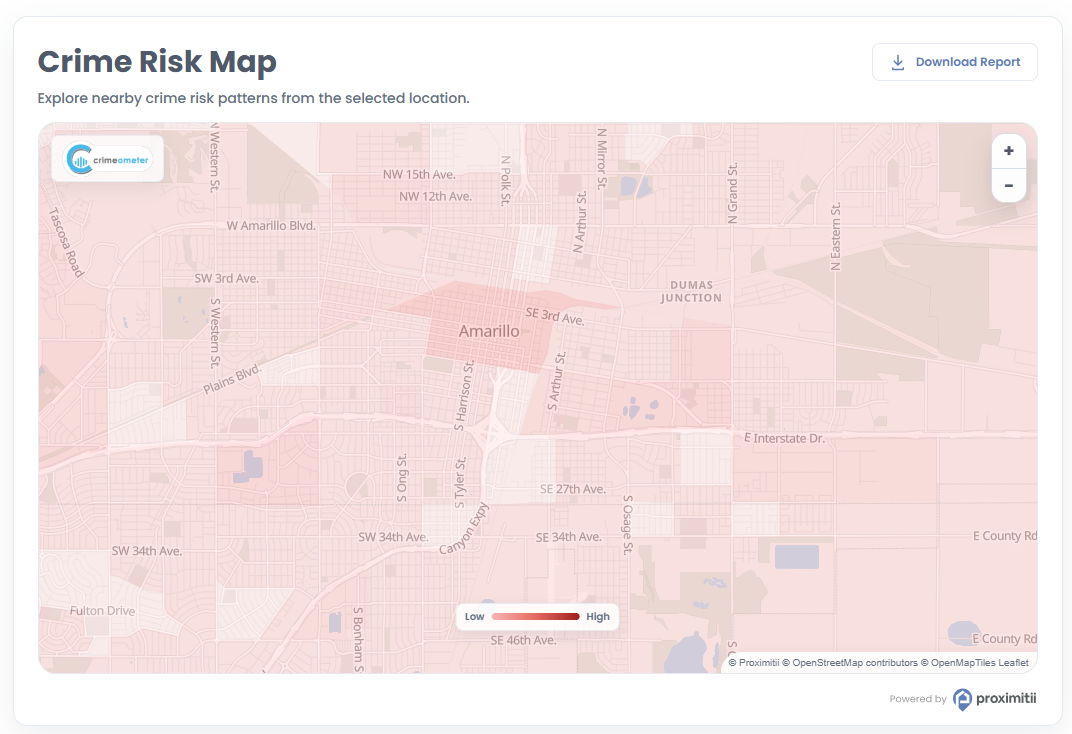

The Fairmount Heights crime rates are 142.5% higher than the national average. There are two main categories of crime - violent crime and property crime. Violent crime consists of murder, rape, robbery and assault, while property crimes include burglary, theft and vehicle theft. There were a total of 19 violent crimes in Fairmount Heights (1285 per 100,000 people), which is 257.7% higher than the national average and there were a total of 57 property crimes (3854 per 100,000 residents) which is 119% higher than average.
With a total of 5139 crimes per 100,000 people, the Fairmount Heights crime rates stand at 142.48 higher than the national average. Consequently, the area grapples with one of the nation's highest total crime rates. Addressing this challenge is crucial for enhancing the safety and livability in Fairmount Heights, making it a priority to reduce crime through community engagement, effective law enforcement, and collaborative efforts to secure a better future for residents and prospective residents.
Fairmount Heights is one of the most dangerous cities in America with a violent crime rate of 1285 per 100,000 people - this ranks in the bottom 10% of all U.S. cities that reported crime. Your chance of being a victim of violent crime in Fairmount Heights is 1 in 78.
In the most recently reported crime year, Fairmount Heights registered zero reported homicides. This statistic not only designates the area as an exemplar of security but also emanates a profound sense of safety within its community. A minimal incidence of severe violent crime not only fosters a strong sense of well-being among residents but also sets a commendable standard for other regions aiming to cultivate similarly safe surroundings.
Fairmount Heights reports one of the nation's highest property crime rates, with 3854 incidents per 100,000 people, positioning it among the worst 10% of American cities reporting crime. This unfortunate statistic translates to a 1 in 26 chance of falling victim to property crime in Fairmount Heights, significantly surpassing the national average. These figures underscore the city's challenges in combating property-related offenses, necessitating a concerted effort to enhance security and community safety.
With a total of 25 vehicle thefts last year, Fairmount Heights has one of the most stolen cars in the country at 1690 per 100,000 people. This lands Fairmount Heights in the bottom 10% of all cities that reported crime and the chance of any vehicle being stolen is one in 60.
AreaVibes conducted surveys inquiring about the safety perception of Fairmount Heights residents. Out of the respondents (6 in total), 33% expressed a strong sense of security, believing that crime rates in Fairmount Heights were low, and they felt comfortable walking alone at night. Conversely, 67% held a contrasting viewpoint, expressing concerns about safety in the area and feeling uncomfortable walking alone during the nighttime hours.
Determining whether Fairmount Heights is a place to live may not always yield a simple answer, given the city's varying safety levels across different areas. Nonetheless, comprehending the city's overall crime rate can be a valuable asset. In broad terms, Fairmount Heights has an overall crime rate that is 142% higher than the national average. When we take a look at crime on a daily basis, this translates into 0.21 daily occurrences, comprising 0.05 violent crimes and 0.16 property crimes. Scrutinizing these statistics provides a foundation for a more informed assessment of the suitability of Fairmount Heights as a potential place to establish residency.
Year-over-year crime data allows us to analyze short-term trends in crime activity. By comparing crime rates from one year to the next, we can identify patterns and shifts in Fairmount Heights crime rates. This information can be invaluable for residents looking to make informed decisions on where to live. When comparing the most recent year to the previous year, total crime in Fairmount Heights has increased by 46.2% year over year. Violent crime has increased by 90% and property crime has increased by 35.7%.
Regions characterized by high population density frequently encompass expansive urban hubs that offer diverse economic prospects. In such areas, income inequality can be exacerbated, creating pockets of poverty alongside affluence. Economic disparities within these regions may correlate with elevated property crimes and, in certain instances, violent crimes. Conversely, areas with low population density numbers generally exhibit reduced Fairmount Heights crime rates. Fairmount Heights registers a population density of 5340.2 people per square mile, in contrast to the national average of 90.6 people per square mile.
Escalating cost of living expenses, encompassing exorbitant housing costs, grocery and healthcare expenditures, can induce financial strain on individuals and families, particularly those with limited financial resources. Such economic stress may propel individuals towards criminal activities, including theft or burglary, as a means of addressing their financial hardships. Conversely, cities characterized by a lower cost of living may alleviate economic pressures, potentially resulting in a reduced crime rate. In Fairmount Heights, the cost of living is 22.62% higher than the national average, reflecting a more affordable economic environment that could contribute to a decrease in crime levels.
Fairmount Heights has a ratio of police officers and civilians per 1,000 residents that differs from the national norm, with 0.66 officers and civilians per 1,000 residents, compared to 3.25 nationwide. Crime rates are profoundly influenced by the effectiveness of law enforcement and community policing endeavors. A resilient and cooperative partnership between law enforcement agencies and the community can serve as a deterrent to criminal activities, ultimately enhancing safety. The efficacy of law enforcement extends beyond mere numbers and extends into the realm of community policing strategies, emphasizing the cultivation of trust and collaboration between officers and the community. It is not merely a matter of quantity but the quality of engagement with the community that matters most.

| Item | Fairmount Heights | Maryland | National |
| Law enforcement employees (officers & civilians) | 1 | 5,343 | 558,732 |
| Police officers & civilians /1000 residents | 0.7 | 3.3 | 3.3 |
| State | Total offenders | Maryland /100K | National /100K |
| Maryland | 7,370 | 135 | 266 |
| City | Population | Violent crime/100k people | Property crime/100k people | Total crime/100k people |
| Martin's Additions, MD | 1,119 | 59 | 288 | 347 |
| Derwood, MD | 1,693 | 59 | 288 | 347 |
| Chevy Chase View, MD | 1,184 | 59 | 288 | 347 |
| Chevy Chase town, MD | 3,037 | 66 | 322 | 387 |
| Chevy Chase, MD | 3,039 | 66 | 322 | 387 |
| Cabin John, MD | 2,355 | 66 | 322 | 387 |
| Kensington, MD | 2,290 | 66 | 322 | 387 |
| Fairmount Heights, MD | 1,414 | 1,285 | 3,854 | 5,139 |
| City | Population | Violent crime/100k people | Property crime/100k people | Total crime/100k people |
| Bourne, MA | 1,414 | 275 | 970 | 1,245 |
| Glyndon, MN | 1,414 | 0 | 291 | 291 |
| Hays, NC | 1,414 | 175 | 918 | 1,093 |
| Molino, FL | 1,414 | 98 | 519 | 617 |
| Gilcrest, CO | 1,415 | 215 | 1,169 | 1,384 |
| Fairmount Heights, MD | 1,414 | 1,285 | 3,854 | 5,139 |

 Here are the best places to live in Maryland
 Safest States In The US
 These are the 10 cheapest cities in Maryland
 Check out the 10 safest cities in Maryland