
| Statistic | Reportedincidents | /100k people | Santa Fe/100k people | New Mexico/100k people | National/100k people |
| Total crime | 5,378 | n/a (estimate) | 5,999 | 3,468 | 2,119 |
| Murder | 4 | n/a | 4.5 | 10.5 | 5.0 |
| Rape | 58 | n/a | 64.7 | 53.8 | 37.5 |
| Robbery | 80 | n/a | 89.2 | 65.3 | 60.6 |
| Assault | 613 | n/a | 683.8 | 587.5 | 256.1 |
| Violent crime | 755 | n/a (estimate) | 842 | 717 | 359 |
| Burglary | 873 | n/a | 973.8 | 500.3 | 229.2 |
| Theft | 3,031 | n/a | 3,380.9 | 1,750.9 | 1,272.1 |
| Vehicle theft | 719 | n/a | 802.0 | 499.9 | 258.8 |
| Property crime | 4,623 | n/a (estimate) | 5,157 | 2,751 | 1,760 |

When we analyze the latest crime report, the Santa Fe crime rate is 183.1% higher than the national average. These incidents are classified into two primary categories: violent and property crimes. Violent crimes include assault, robbery, rape and murder. Whereas property crimes encompass theft, vehicle theft and burglary. In the case of Santa Fe, there were 755 reported violent crimes, equivalent to 842 per 100,000 individuals, 134.5% higher than the national average. Additionally, Santa Fe recorded 4623 property crimes, amounting to 5157 per 100,000 residents, 193% higher than the U.S. average.
Having a crime rate of 5999 per 100,000 residents, Santa Fe experiences a crime rate that is 183.07% higher when compared to the national average, leading to one of the highest overall crime rates in the nation. It's important to clarify that this doesn't imply the entire city is unsafe. Like any area, Santa Fe contains neighborhoods with varying safety levels and you can find areas that are notably safer than others, emphasizing the need for targeted crime prevention efforts and community engagement initiatives.
Santa Fe is one of the most dangerous cities in America with a violent crime rate of 842 per 100,000 people - this ranks in the bottom 10% of all U.S. cities that reported crime. Your chance of being a victim of violent crime in Santa Fe is 1 in 119.
Santa Fe faces some of the nation's most elevated property crime rates, recording 5157 incidents per 100,000 people. This places the city among the worst 10% of all U.S. cities that reported crime. Regrettably, the likelihood of falling victim to property crime in Santa Fe stands at 1 in 20, significantly surpassing the national average. These statistics underscore the imperative need for bolstered community safety measures to mitigate property crimes and enhance the well-being of its residents.
With a total of 719 vehicle thefts last year, Santa Fe has one of the most stolen cars in the country at 802 per 100,000 people. This lands Santa Fe in the bottom 10% of all cities that reported crime and the chance of any vehicle being stolen is one in 125.
AreaVibes surveyed 114 local residents in Santa Fe to gauge the safety of the area. Based on the results, 40% of people answered that there was very little crime in Santa Fe and that they felt very comfortable walking alone at night. Another 60% of people responded that there was far too much crime and they would be hesitant to walk the streets alone at night. Keep in mind that the opinions of residents may vary depending on which area they live in.
Determining whether Santa Fe is a place to live may not always yield a simple answer, given the city's varying safety levels across different areas. Nonetheless, comprehending the city's overall crime rate can be a valuable asset. In broad terms, Santa Fe has an overall crime rate that is 183% higher than the national average. When we take a look at crime on a daily basis, this translates into 14.73 daily occurrences, comprising 2.07 violent crimes and 12.67 property crimes. Scrutinizing these statistics provides a foundation for a more informed assessment of the suitability of Santa Fe as a potential place to establish residency.
Santa Fe has a poverty rate that stands at 14.3, in contrast to the national average of 15.1. Historically, a direct correlation has been observed between poverty rates and crime stats. Higher poverty rates have led to higher crime rates, while lower poverty rates have led to a reduction in Santa Fe crime rates. Income disparities and heightened poverty levels can serve as catalysts for elevated or reduced criminal activity, as individuals may or may not turn to illicit means to fulfill their basic needs. This could be one of many factors that may influence crime.
In areas where employment options are limited or where a significant proportion of jobs offer meager wages, the likelihood of heightened unemployment and homelessness increases. Regions facing challenges related to unemployment or inadequate income may become more vulnerable to a surge in crime stemming from economic instability. While low unemployment rates tend to lead to reduced crime in most areas. Santa Fe currently has an unemployment rate of 3.1%, contrasting with the national average of 4.9%. This could be one of many factors that could contribute to a higher or lower crime rate.
In Santa Fe, 83.8% of residents have graduated from high school, whereas the national average stands at 83%. The educational makeup of a community can exert a significant influence on crime rates. Typically, higher levels of educational attainment are associated with reduced crime rates, as they furnish individuals with improved employment prospects and viable alternatives to engaging in criminal activities. Conversely, communities characterized by lower educational achievement often grapple with higher crime rates, as limited opportunities may drive individuals towards criminal behavior.

| Item | Santa Fe | New Mexico | National |
| Law enforcement employees (officers & civilians) | 201 | 3,705 | 558,732 |
| Police officers & civilians /1000 residents | 2.9 | 4.4 | 3.3 |
| State | Total offenders | New Mexico /100K | National /100K |
| New Mexico | 3,129 | 155 | 266 |
| City | Population | Violent crime/100k people | Property crime/100k people | Total crime/100k people |
| Nambe, NM | 2,035 | 184 | 705 | 889 |
| El Rancho, NM | 1,434 | 203 | 778 | 980 |
| La Cienega, NM | 3,855 | 214 | 822 | 1,036 |
| Eldorado at Santa Fe, NM | 5,683 | 233 | 895 | 1,128 |
| White Rock, NM | 6,052 | 233 | 895 | 1,128 |
| Cuyamungue Grant, NM | 275 | 290 | 1,111 | 1,401 |
| Chupadero, NM | 263 | 290 | 1,111 | 1,401 |
| Santa Fe, NM | 86,648 | 842 | 5,157 | 5,999 |
| City | Population | Violent crime/100k people | Property crime/100k people | Total crime/100k people |
| Whittier, CA | 86,613 | 490 | 2,375 | 2,866 |
| Trenton, NJ | 86,528 | 1,026 | 2,289 | 3,314 |
| Lake Forest, CA | 86,858 | 146 | 830 | 975 |
| Danbury, CT | 86,891 | 262 | 1,257 | 1,519 |
| Merced, CA | 86,383 | 785 | 2,793 | 3,577 |
| Santa Fe, NM | 86,648 | 842 | 5,157 | 5,999 |

 Here are the best places to live in New Mexico
 Safest States In The US
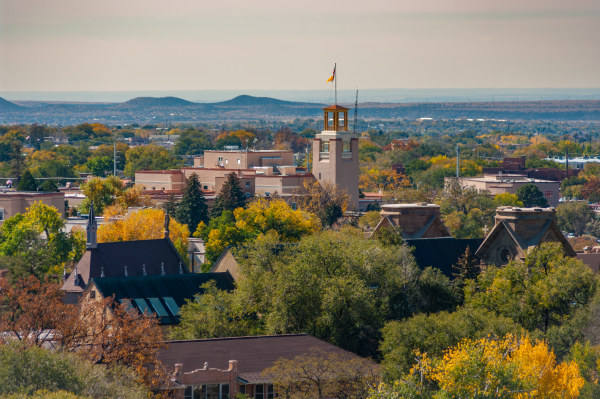 See the best places to live in Santa Fe
 These are the 10 cheapest cities in New Mexico