
| Statistic | Reportedincidents | /100k people | Pleasanton/100k people | Kansas/100k people | National/100k people |
| Total crime | 6 | n/a (estimate) | 502 | 2,395 | 2,119 |
| Murder | 0 | n/a | 0.0 | 3.8 | 5.0 |
| Rape | 0 | n/a | 0.0 | 44.1 | 37.5 |
| Robbery | 0 | n/a | 0.0 | 30.9 | 60.6 |
| Assault | 4 | n/a | 334.7 | 359.9 | 256.1 |
| Violent crime | 4 | n/a (estimate) | 335 | 439 | 359 |
| Burglary | 0 | n/a | 0.0 | 261.6 | 229.2 |
| Theft | 2 | n/a | 167.4 | 1,458.5 | 1,272.1 |
| Vehicle theft | 0 | n/a | 0.0 | 236.3 | 258.8 |
| Property crime | 2 | n/a (estimate) | 167 | 1,956 | 1,760 |
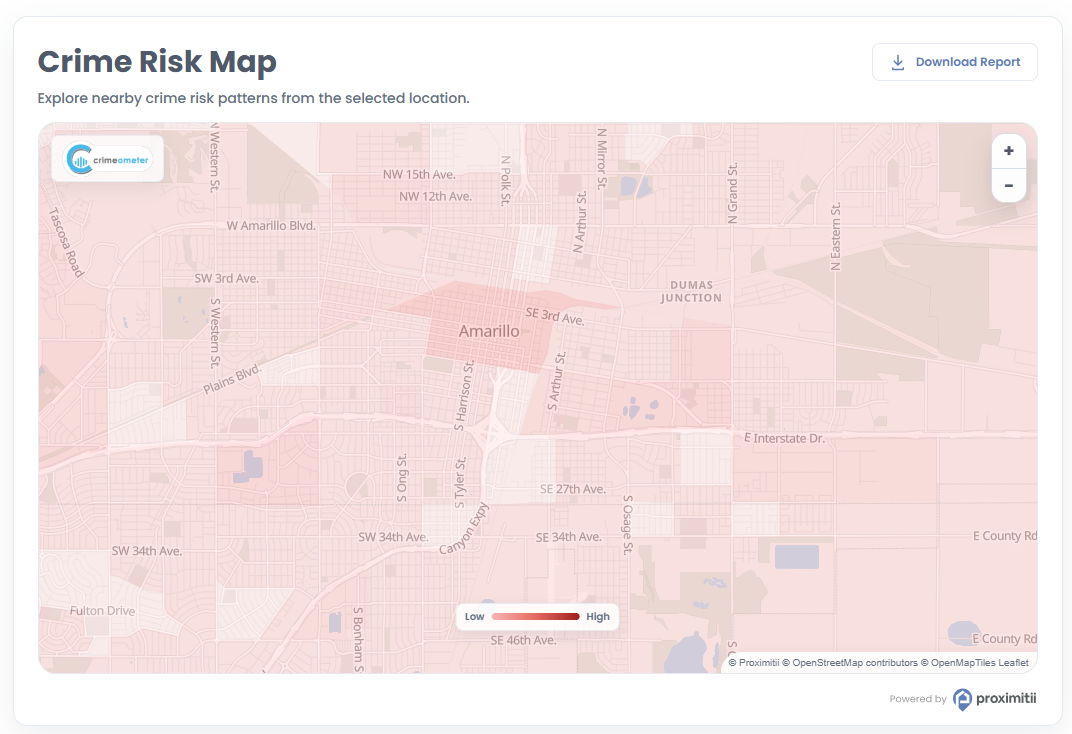
When we analyze the latest crime report, the Pleasanton crime rate is 76.3% lower than the national average. These incidents are classified into two primary categories: violent and property crimes. Violent crimes include assault, robbery, rape and murder. Whereas property crimes encompass theft, vehicle theft and burglary. In the case of Pleasanton, there were 4 reported violent crimes, equivalent to 335 per 100,000 individuals, 6.8% lower than the national average. Additionally, Pleasanton recorded 2 property crimes, amounting to 167 per 100,000 residents, 90.5% lower than the U.S. average.
Pleasanton enjoys a remarkably low crime rate, standing at just 502, a significant contrast to the national average of 2119. This distinction firmly establishes Pleasanton as one of the safest places to reside in the entire United States. This crime rate is meticulously calculated, taking into account the total occurrences of both violent and property crimes per 100,000 individuals, providing a comprehensive perspective on the area's safety and livability.
The violent crime rate in Pleasanton closely mirrors the national average among all cities that reported crime, with 335 incidents per 100,000 people. The national average for violent crime per 100,000 people was 359. This consistency highlights Pleasanton as a community where safety standards are in line with the broader national landscape, providing residents with a reliable sense of security.
Pleasanton showcased a dedication to violent crime safety in its latest reported crime year by achieving a murder rate of 0. This accomplishment could indicate that it is a safe place for residents, but also provides a shining example to other urban areas endeavoring to create safer communities.
In 1991, property crime rates in the United States soared to over 5,140 crimes per 100,000 people. In the years since, the U.S. property crime rate has continued to decline with the most recent year reporting only 1760 property crimes. In Pleasanton, the property crime rate was even less than the national average with a rate of 167, cementing it as one of the safest places to live with regards to property crime.
The United States contends with some of the world's highest vehicle theft rates, with approximately 300 vehicle thefts per 100,000 individuals. Remarkably, only a modest fraction, approximately 10%, of cities have been fortunate enough to have zero reported instances of stolen vehicles. Pleasanton stands out as one of these cities, as it reported no vehicle thefts in the most recent crime report, underscoring its commitment to a secure environment.
To get a feel for the safety of living in Pleasanton, it's essential to analyze both the overall crime rate and the daily incident count. Pleasanton presents a total crime rate that is 76% lower than the national average per 100,000 residents. Consequently, Pleasanton experiences an average of 0.02 daily crimes, comprising 0.01 violent incidents and 0.01 property-related offenses. This evaluation offers a comprehensive understanding of the safety landscape, aiding individuals in making informed decisions when considering relocation.
Examining year-over-year crime data provides insights into short-term trends with regards to the crime activity in Pleasanton. This analysis involves comparing crime rates from one year to the next, enabling the identification of patterns and fluctuations in crime. Such information proves invaluable to residents seeking to make well-informed decisions about their choice of residence. In the most recent year, compared to the previous one, total crime in Pleasanton has decreased by 66.7%. Specifically, violent crime has didn't change by 0%, while property crime has decreased by 85.7%. This data empowers individuals with a clearer understanding of the evolving safety landscape in Pleasanton.
The economic well-being of a city's residents plays a significant role in crime rates. High poverty rates and income inequality can lead to increased crime stats as individuals may resort to illegal activities to meet their basic needs. While lower rates could lead to a lower Pleasanton crime rate. The poverty level in Pleasanton is 16.9%, while the national average is 15.1%.
Regions characterized by high population density frequently encompass expansive urban hubs that offer diverse economic prospects. In such areas, income inequality can be exacerbated, creating pockets of poverty alongside affluence. Economic disparities within these regions may correlate with elevated property crimes and, in certain instances, violent crimes. Conversely, areas with low population density numbers generally exhibit reduced Pleasanton crime rates. Pleasanton registers a population density of 807.6 people per square mile, in contrast to the national average of 90.6 people per square mile.
The educational level achieved in any given city can influence crime rates significantly. Greater educational achievement is frequently associated with decreased crime rates, as it offers individuals improved job prospects and alternatives to engaging in crime related activities. Conversely, lower educational attainment rates tend to coincide with elevated crime rates. In Pleasanton, 83.9% of residents have successfully graduated from high school, in contrast to the national average where 83% have achieved high school graduation.

| Item | Pleasanton | Kansas | National |
| Law enforcement employees (officers & civilians) | 2 | 5,262 | 558,732 |
| Police officers & civilians /1000 residents | 1.6 | 2.5 | 3.3 |
| State | Total offenders | Kansas /100K | National /100K |
| Kansas | 9,632 | 349 | 266 |
| City | Population | Violent crime/100k people | Property crime/100k people | Total crime/100k people |
| La Cygne, KS | 1,195 | 204 | 908 | 1,111 |
| Linn Valley, KS | 895 | 413 | 1,840 | 2,253 |
| Foster, MO | 75 | 575 | 2,414 | 2,988 |
| Mound City, KS | 787 | 549 | 2,445 | 2,993 |
| Hume, MO | 314 | 584 | 2,452 | 3,036 |
| Amsterdam, MO | 208 | 649 | 2,725 | 3,374 |
| Prescott, KS | 286 | 624 | 2,781 | 3,406 |
| Pleasanton, KS | 1,484 | 335 | 167 | 502 |
| City | Population | Violent crime/100k people | Property crime/100k people | Total crime/100k people |
| Paincourtville, LA | 1,484 | 203 | 897 | 1,101 |
| Fort Loramie, OH | 1,484 | 60 | 315 | 375 |
| Kenton, TN | 1,484 | 281 | 965 | 1,247 |
| Chesilhurst, NJ | 1,484 | 102 | 669 | 771 |
| Rome City, IN | 1,484 | 53 | 233 | 286 |
| Pleasanton, KS | 1,484 | 335 | 167 | 502 |

 Here are the best places to live in Kansas
 Most Dangerous Cities In The US
 Safest States In The US
 Safest Cities In The US