
| Index | Dubuque | Iowa | National |
| Cost of living | 92 | 89 | 100 |
| Groceries | 98 | 97 | 100 |
| Health care | 96 | 96 | 100 |
| Housing | 83 | 74 | 100 |
| Transportation | 96 | 97 | 100 |
| Utilities | 93 | 95 | 100 |
| Lifestyle & Entertainment | 97 | 95 | 100 |
| Household Items | 97 | 97 | 100 |
| Education & Childcare | 89 | 94 | 100 |

Understanding the cost of living in Dubuque can help future residents assess whether their current financial situation aligns with the expenses they will encounter. It enables them to plan for potential changes in their budget and lifestyle. The Dubuque cost of living index is 92, which is 8% lower than the national average. The cost of living index is calculated by taking into account multiple categories, which encompass both the cost of everyday expenditures and larger expenses as well.
Everyday expenditures like food, housing, lifestyle expenses, transportation and health care in Dubuque are priced in a manner consistent with other areas. This means that residents of Dubuque can anticipate their daily expenses remaining reasonably similar to those in an average city, thereby supporting a manageable cost of living.
Locals have the inside scoop on their city. So, we polled 18 residents in Dubuque to learn how they view the cost of living. We asked how they felt about the cost of living in their area, and if they thought that prices were increasing, decreasing or staying the same. The verdict? 56% find it reasonable with decreasing prices, but 44% think it's quite pricey, with prices that continue to rise.
Is Dubuque affordable? It's a key consideration when pondering a move, as affordability often shapes your choices. The cost of living index (we discussed it earlier), coupled with housing costs and income levels, serves as the cornerstone for determining a location's affordability. Take Dubuque, for instance, where the median home price falls 17.4% lower than the national average, and monthly rent rates are 16.3% lower than usual. Additionally, median income levels contribute to the equation, with Dubuque flaunting a median household income of $83,245, 2.4% higher than the national norm.
Housing: Elevated demand for housing within coveted locales has the propensity to escalate both property values and rental rates, thereby serving as a primary catalyst for an augmented cost of living. Conversely, areas witnessing diminished housing demand, particularly within less desirable environs, often experience an inversely proportional effect, leading to price reductions and subsequently contributing to a more modest cost of living. In Dubuque, the housing index is 17.1% lower than the national average.
Groceries: Grocery expenditures have undergone notable escalation over the last 2-3 years. In some markets, the cost of food products has surged by more than 20%, while others have experienced only modest increments. These fluctuations in food costs can have a significant impact on the overall cost of living in any region. In Dubuque, the groceries index registers 2.3% lower than the national average.
Urbanization: Urban areas with a wealth of amenities and employment opportunities tend to come with a higher price tag for living. Why? Well, more people want to be there, which drives up home prices and rents. On the flip side, less densely populated rural areas or places where there's not as much demand usually mean fewer attractions, things to do and slower job growth. That often results in a lower cost of living.
The Dubuque cost of living data displayed above uses a U.S. average baseline of 100 to provide a practical way to compare living expenses across cities. Housing estimates incorporate U.S. Census home price and rental data, while all other values are generated using AI-assisted models based on everyday expense expectations, regional pricing trends, climate, transportation patterns, and local economic conditions. These values are designed for directional city-to-city comparisons.

| Cost of living index | |
| Groceries index | |
| Health care index | |
| Housing index | |
| Transportation index | |
| Utilities index | |
| Lifestyle index | |
| Household index | |
| Educare index |
| Median Income | Per Year | Per Month | Max Budget (28% DTI) | Max Budget (36% DTI) |
| Owners | $103,952 | $8,663 | $2,425 | $3,119 |
| Renters | $49,101 | $4,092 | $1,146 | $1,473 |
| State | General Sales Tax | With Max Surtax |
| Iowa | 6% | 7% |
| State | Income Tax (Low) | Income Tax (High) |
| Iowa | 4.4% | 6% |
| City | Population | Cost of Living Index | National Avg. |
| Bernard, IA | 144 | 86 | 13.8% |
| La Motte, IA | 249 | 86 | 13.6% |
| Zwingle, IA | 73 | 87 | 13.0% |
| Benton, WI | 886 | 87 | 12.9% |
| East Dubuque, IL | 1,603 | 88 | 12.1% |
| Dubuque, IA | 59,811 | 92 | 8.3% |
| City | Population | Cost of Living Index | National Avg. |
| Margate, FL | 59,787 | 110 | 9.5% |
| White Plains, NY | 59,856 | 160 | 60.3% |
| Hendersonville, TN | 59,856 | 111 | 11.4% |
| Sarasota, FL | 59,705 | 118 | 18.1% |
| South Whittier, CA | 59,924 | 156 | 55.8% |
| Dubuque, IA | 59,811 | 92 | 8.3% |

 Here are the best places to live in Iowa
 Most Dangerous States In The US
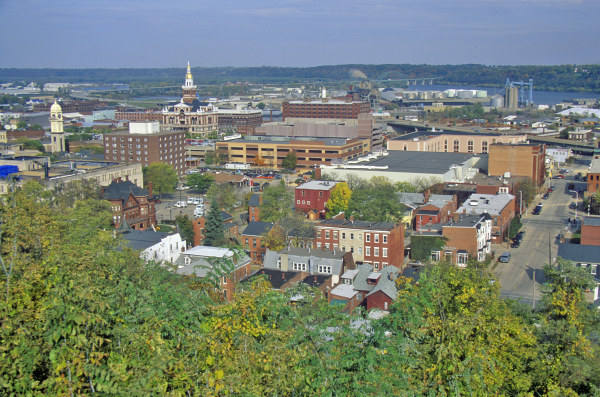 See the best places to live in Dubuque
 Check out the 10 most dangerous cities in Iowa