
| Statistic | Reportedincidents | /100k people | Capitol Heights/100k people | Maryland/100k people | National/100k people |
| Total crime | 59 | n/a (estimate) | 1,503 | 2,470 | 2,119 |
| Murder | 0 | n/a | 0.0 | 7.2 | 5.0 |
| Rape | 1 | n/a | 25.5 | 33.0 | 37.5 |
| Robbery | 11 | n/a | 280.2 | 123.2 | 60.6 |
| Assault | 6 | n/a | 152.8 | 257.0 | 256.1 |
| Violent crime | 18 | n/a (estimate) | 458 | 420 | 359 |
| Burglary | 3 | n/a | 76.4 | 190.0 | 229.2 |
| Theft | 12 | n/a | 305.7 | 1,446.8 | 1,272.1 |
| Vehicle theft | 26 | n/a | 662.3 | 412.8 | 258.8 |
| Property crime | 41 | n/a (estimate) | 1,044 | 2,050 | 1,760 |
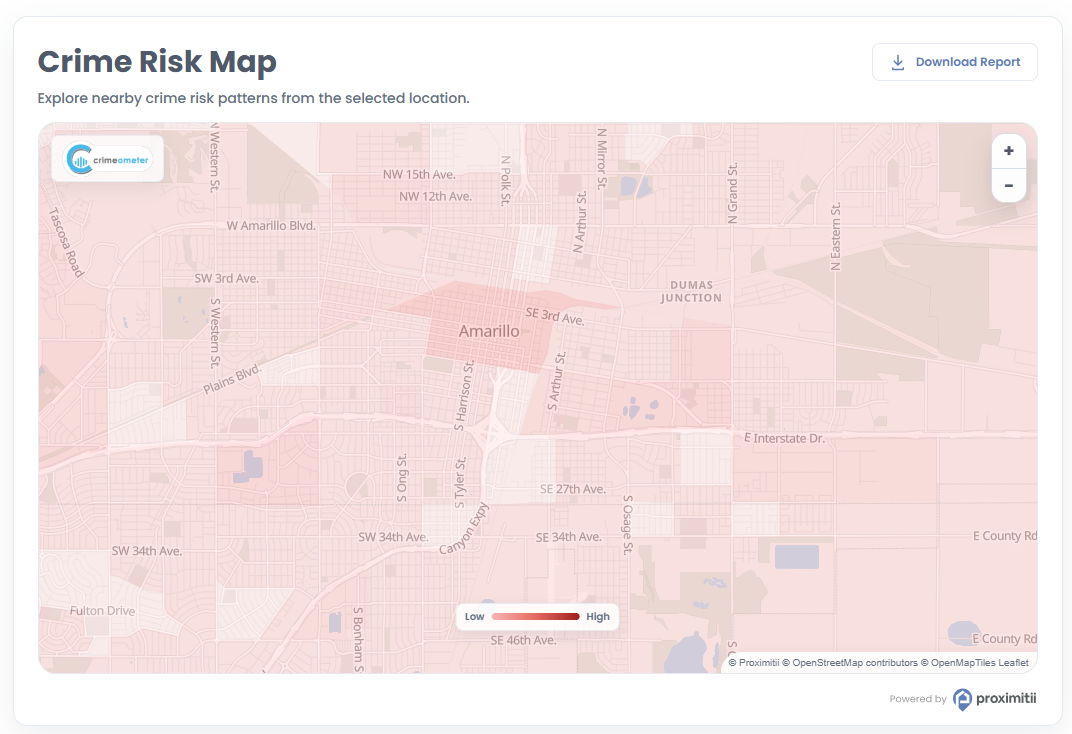

The Capitol Heights crime rates are 29.1% lower than the national average. There are two main categories of crime - violent crime and property crime. Violent crime consists of murder, rape, robbery and assault, while property crimes include burglary, theft and vehicle theft. There were a total of 18 violent crimes in Capitol Heights (458 per 100,000 people), which is 27.7% higher than the national average and there were a total of 41 property crimes (1044 per 100,000 residents) which is 40.7% lower than average.
In a remarkable testament to the city's commitment to safety, Capitol Heights reported a murder rate of 0. This could indicate that it is a very safe place to live, but also serves as an inspiration to other urban areas striving for safer communities. Examining the full crime report will provide a complete overview of all crimes - violent and property.
The surge in vehicle thefts is a concerning trend across the United States, and Capitol Heights is no exception, experiencing one of the nation's highest vehicle theft rates. Last year, Capitol Heights reported a total of 26 vehicle thefts, resulting in 662 stolen vehicles per 100,000 people. This places the city in the lowest 10% tier among all cities, indicating that 90% of cities have less stolen vehicles. The probability of a vehicle being stolen stands at 1 in 151, underscoring the need for heightened vigilance and security measures.
What do the local residents think about crime in Capitol Heights? Well, based on a recent survey of 16 people (conducted by AreaVibes), 63% of Capitol Heights residents said that there was virtually no crime and that they felt safe walking at night. Another 38% of respondents said that there was too much crime in the area and they did not feel safe walking alone at night.
Is Capitol Heights a safe place to live? While the answer may not be straightforward due to variations in safety levels across the city, gaining an understanding of the overall crime rate can prove to be advantageous. In general, Capitol Heights has a crime rate that is lower than the national average by 29%. Breaking this down on a daily basis, it translates to 0.16 daily incidents, encompassing 0.05 violent crimes and 0.11 property crimes. Evaluating these statistics can aid in forming a more informed perspective on the safety of Capitol Heights as a potential place to call home.
Year-over-year crime data allows residents and potential residents to assess the crime in Capitol Heights. A decrease in crime rates may indicate improving safety, while an increase could raise concerns. The year-over-year crime rate in Capitol Heights has decreased by 25.3%. Violent crimes have decreased by 5.3%, while property crimes have decreased by 31.7%. By comparing crime rates from one year to the next, authorities and communities can identify trends and patterns in criminal activity. This helps in understanding whether crime is increasing, decreasing, or remaining stable over time.
In areas where employment options are limited or where a significant proportion of jobs offer meager wages, the likelihood of heightened unemployment and homelessness increases. Regions facing challenges related to unemployment or inadequate income may become more vulnerable to a surge in crime stemming from economic instability. While low unemployment rates tend to lead to reduced crime in most areas. Capitol Heights currently has an unemployment rate of 4.5%, contrasting with the national average of 4.9%. This could be one of many factors that could contribute to a higher or lower crime rate.
Highly populated regions typically encompass expansive urban hubs teeming with diverse economic prospects. Within these areas, income inequality can be exacerbated, giving rise to enclaves of poverty amid affluence. Communities marked by economic disparities may contend with heightened property crimes, and in certain instances, violent crimes. Conversely, regions characterized by low population density often exhibit lower Capitol Heights crime rates. For instance, in Capitol Heights, the population density stands at 5903 people per square mile, diverging from the national average of 90.6 people per square mile.
High cost of living can lead to economic stress for individuals and families, particularly those with limited financial resources. When people struggle to make ends meet due to high housing costs, healthcare expenses, or other basic necessities, they may be more inclined to engage in criminal activities, such as theft or fraud, as a means of financial survival. On the flipside, cities that have a lower cost of living, could see a reduced crime rate. In Capitol Heights, the cost of living is 15.96% higher than the national average.

| Item | Capitol Heights | Maryland | National |
| Law enforcement employees (officers & civilians) | 8 | 5,343 | 558,732 |
| Police officers & civilians /1000 residents | 1.8 | 3.3 | 3.3 |
| State | Total offenders | Maryland /100K | National /100K |
| Maryland | 7,370 | 135 | 266 |
| City | Population | Violent crime/100k people | Property crime/100k people | Total crime/100k people |
| Baden, MD | 1,632 | 59 | 288 | 347 |
| Martin's Additions, MD | 1,119 | 59 | 288 | 347 |
| Chevy Chase View, MD | 1,184 | 59 | 288 | 347 |
| Chevy Chase town, MD | 3,037 | 66 | 322 | 387 |
| Chevy Chase, MD | 3,039 | 66 | 322 | 387 |
| Cabin John, MD | 2,355 | 66 | 322 | 387 |
| Kensington, MD | 2,290 | 66 | 322 | 387 |
| Capitol Heights, MD | 4,609 | 458 | 1,044 | 1,503 |
| City | Population | Violent crime/100k people | Property crime/100k people | Total crime/100k people |
| East Petersburg, PA | 4,608 | 139 | 810 | 949 |
| Newport, SC | 4,608 | 147 | 661 | 808 |
| Wahoo, NE | 4,610 | 99 | 536 | 635 |
| Buhl, ID | 4,608 | 84 | 336 | 420 |
| Royal Pines, NC | 4,610 | 98 | 511 | 609 |
| Capitol Heights, MD | 4,609 | 458 | 1,044 | 1,503 |

 Here are the best places to live in Maryland
 Most Dangerous Cities In The US
 Check out the 10 safest cities in Maryland
 Most Dangerous States In The US