
| Statistic | Reportedincidents | /100k people | Brownfield/100k people | Texas/100k people | National/100k people |
| Total crime | 145 | n/a (estimate) | 1,692 | 2,430 | 2,119 |
| Murder | 1 | n/a | 11.7 | 5.2 | 5.0 |
| Rape | 2 | n/a | 23.3 | 50.0 | 37.5 |
| Robbery | 1 | n/a | 11.7 | 63.5 | 60.6 |
| Assault | 34 | n/a | 396.8 | 270.7 | 256.1 |
| Violent crime | 38 | n/a (estimate) | 443 | 389 | 359 |
| Burglary | 25 | n/a | 291.7 | 284.3 | 229.2 |
| Theft | 74 | n/a | 863.6 | 1,425.6 | 1,272.1 |
| Vehicle theft | 8 | n/a | 93.4 | 330.7 | 258.8 |
| Property crime | 107 | n/a (estimate) | 1,249 | 2,041 | 1,760 |
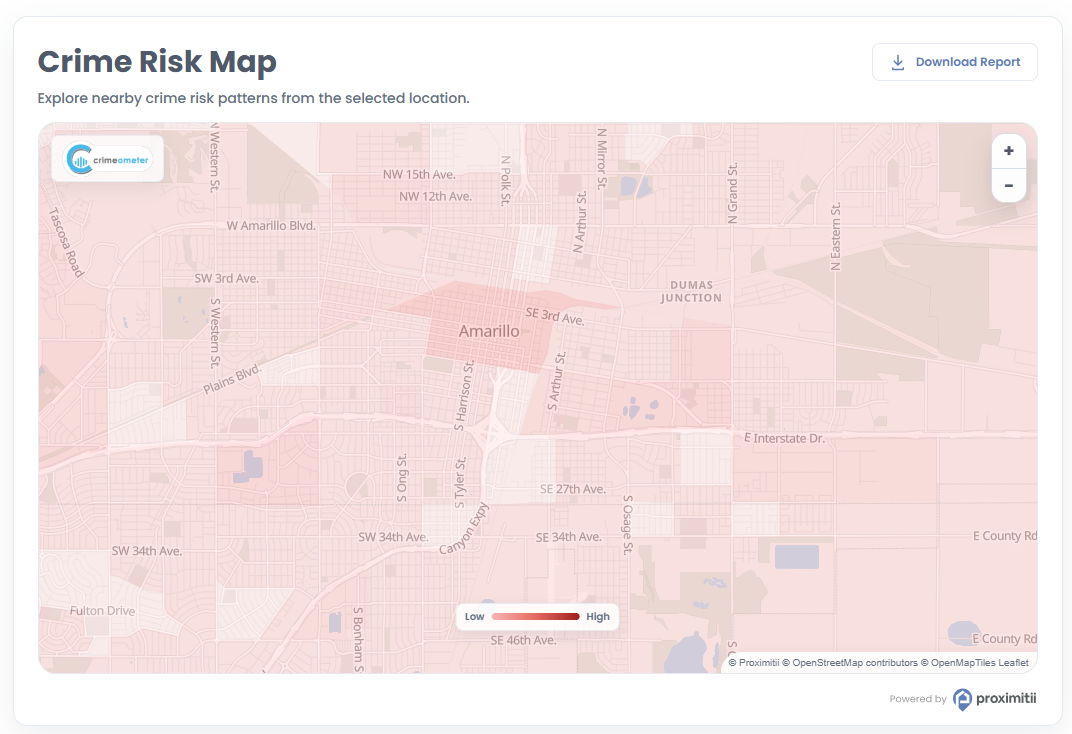
Crime can be categorized into two primary types: violent and property crimes. Violent crimes encompass offenses such as murder, rape, robbery, and assault, whereas property crimes involve acts like burglary, theft, and vehicle theft. The overall crime rate in Brownfield is 20.2% lower than the national average. Specifically, there were 38 violent crimes reported in Brownfield, equivalent to 443 per 100,000 residents, which is higher than the national average by 23.5%. Additionally, Brownfield recorded 107 property crimes, amounting to 1249 per 100,000 people, lower than the national average by 29.1%.
While murder rates in the United States have shown a consistent decline since 1990, recent years have witnessed an increase. Unfortunately, Brownfield ranks among the cities with the highest murder rates in the nation, when compared to all reporting cities in the U.S. In Brownfield, there were a total of 1 murders, translating to 12 murders per 100,000 residents. This alarming statistic underscores the need for heightened attention to community safety and crime prevention efforts in the area.
Is Brownfield a safe place to live? While the answer may not be straightforward due to variations in safety levels across the city, gaining an understanding of the overall crime rate can prove to be advantageous. In general, Brownfield has a crime rate that is lower than the national average by 20%. Breaking this down on a daily basis, it translates to 0.4 daily incidents, encompassing 0.1 violent crimes and 0.29 property crimes. Evaluating these statistics can aid in forming a more informed perspective on the safety of Brownfield as a potential place to call home.
Year-over-year crime data allows residents and potential residents to assess the crime in Brownfield. A decrease in crime rates may indicate improving safety, while an increase could raise concerns. The year-over-year crime rate in Brownfield has increased by 28.3%. Violent crimes have increased by 18.8%, while property crimes have increased by 32.1%. By comparing crime rates from one year to the next, authorities and communities can identify trends and patterns in criminal activity. This helps in understanding whether crime is increasing, decreasing, or remaining stable over time.
The economic well-being of a city's residents plays a significant role in crime rates. High poverty rates and income inequality can lead to increased crime stats as individuals may resort to illegal activities to meet their basic needs. While lower rates could lead to a lower Brownfield crime rate. The poverty level in Brownfield is 26.1%, while the national average is 15.1%.
Highly populated regions typically encompass expansive urban hubs teeming with diverse economic prospects. Within these areas, income inequality can be exacerbated, giving rise to enclaves of poverty amid affluence. Communities marked by economic disparities may contend with heightened property crimes, and in certain instances, violent crimes. Conversely, regions characterized by low population density often exhibit lower Brownfield crime rates. For instance, in Brownfield, the population density stands at 1485.7 people per square mile, diverging from the national average of 90.6 people per square mile.
In Brownfield, the cost of living is 17.48% lower than the national average. A high cost of living can induce economic stress for locals, especially those with limited financial resources. When people grapple with soaring housing expenses, utility bills, healthcare costs, and other essential necessities, they may be driven towards criminal activities, including theft or fraud, as a means of financial survival. Conversely, cities boasting a lower cost of living may mitigate economic pressures and potentially result in reduced crime rates.

| Item | Brownfield | Texas | National |
| Law enforcement employees (officers & civilians) | 22 | 46,020 | 558,732 |
| Police officers & civilians /1000 residents | 2.2 | 3.0 | 3.3 |
| State | Total offenders | Texas /100K | National /100K |
| Texas | 95,281 | 443 | 266 |
| City | Population | Violent crime/100k people | Property crime/100k people | Total crime/100k people |
| Wellman, TX | 223 | 506 | 2,652 | 3,158 |
| Meadow, TX | 933 | 590 | 3,094 | 3,684 |
| Brownfield, TX | 9,675 | 443 | 1,249 | 1,692 |
| City | Population | Violent crime/100k people | Property crime/100k people | Total crime/100k people |
| Augusta, KS | 9,678 | 281 | 1,763 | 2,044 |
| Fair Oaks, GA | 9,671 | 314 | 1,611 | 1,925 |
| Fairview, OR | 9,680 | 224 | 1,613 | 1,837 |
| Ecorse, MI | 9,684 | 562 | 1,785 | 2,347 |
| Hackettstown, NJ | 9,665 | 10 | 515 | 525 |
| Brownfield, TX | 9,675 | 443 | 1,249 | 1,692 |

 Here are the best places to live in Texas
 These are the largest cities in Texas
 Safest States In The US
 Most Dangerous States In The US