
| Statistic | Reportedincidents | /100k people | New Deal/100k people | Texas/100k people | National/100k people |
| Total crime | 2 | n/a (estimate) | 271 | 2,430 | 2,119 |
| Murder | 0 | n/a | 0.0 | 5.2 | 5.0 |
| Rape | 0 | n/a | 0.0 | 50.0 | 37.5 |
| Robbery | 0 | n/a | 0.0 | 63.5 | 60.6 |
| Assault | 1 | n/a | 135.7 | 270.7 | 256.1 |
| Violent crime | 1 | n/a (estimate) | 136 | 389 | 359 |
| Burglary | 0 | n/a | 0.0 | 284.3 | 229.2 |
| Theft | 1 | n/a | 135.7 | 1,425.6 | 1,272.1 |
| Vehicle theft | 0 | n/a | 0.0 | 330.7 | 258.8 |
| Property crime | 1 | n/a (estimate) | 136 | 2,041 | 1,760 |
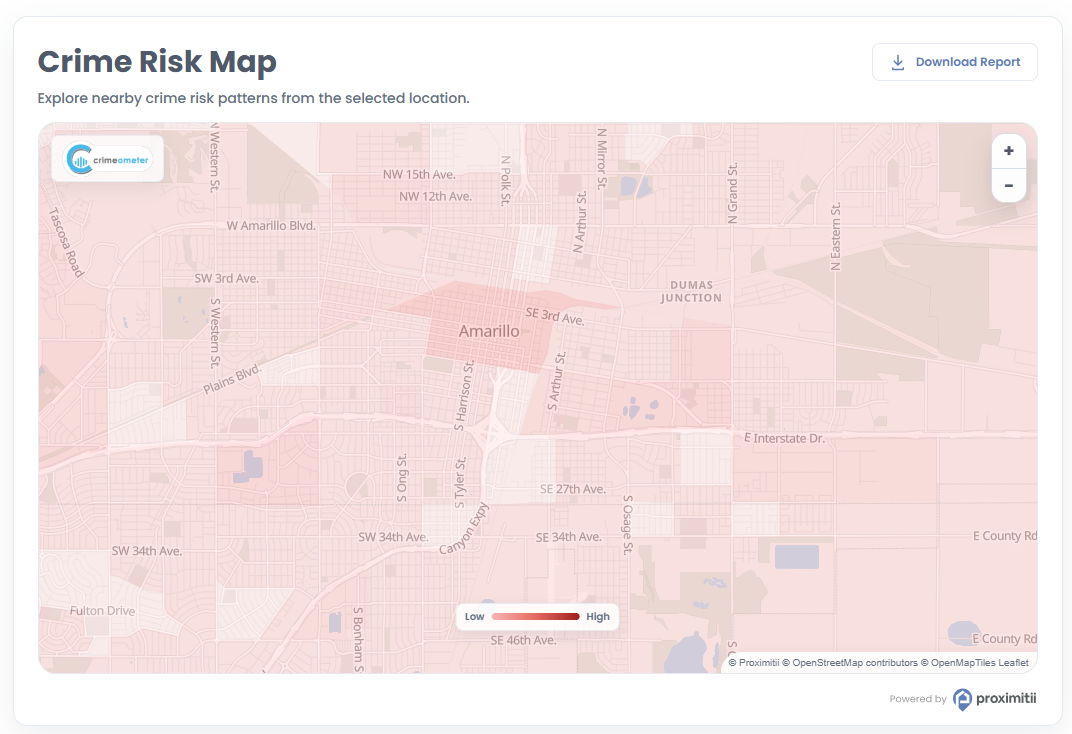

When we analyze the latest crime report, the New Deal crime rate is 87.2% lower than the national average. These incidents are classified into two primary categories: violent and property crimes. Violent crimes include assault, robbery, rape and murder. Whereas property crimes encompass theft, vehicle theft and burglary. In the case of New Deal, there were 1 reported violent crimes, equivalent to 136 per 100,000 individuals, 62.2% lower than the national average. Additionally, New Deal recorded 1 property crimes, amounting to 136 per 100,000 residents, 92.3% lower than the U.S. average.
New Deal enjoys a remarkably low crime rate, standing at just 271, a significant contrast to the national average of 2119. This distinction firmly establishes New Deal as one of the safest places to reside in the entire United States. This crime rate is meticulously calculated, taking into account the total occurrences of both violent and property crimes per 100,000 individuals, providing a comprehensive perspective on the area's safety and livability.
In the most recently reported crime year, New Deal registered zero reported homicides. This statistic not only designates the area as an exemplar of security but also emanates a profound sense of safety within its community. A minimal incidence of severe violent crime not only fosters a strong sense of well-being among residents but also sets a commendable standard for other regions aiming to cultivate similarly safe surroundings.
In 1991, property crime rates in the United States soared to over 5,140 crimes per 100,000 people. In the years since, the U.S. property crime rate has continued to decline with the most recent year reporting only 1760 property crimes. In New Deal, the property crime rate was even less than the national average with a rate of 136, cementing it as one of the safest places to live with regards to property crime.
The United States contends with some of the world's highest vehicle theft rates, with approximately 300 vehicle thefts per 100,000 individuals. Remarkably, only a modest fraction, approximately 10%, of cities have been fortunate enough to have zero reported instances of stolen vehicles. New Deal stands out as one of these cities, as it reported no vehicle thefts in the most recent crime report, underscoring its commitment to a secure environment.
Determining whether New Deal is a place to live may not always yield a simple answer, given the city's varying safety levels across different areas. Nonetheless, comprehending the city's overall crime rate can be a valuable asset. In broad terms, New Deal has an overall crime rate that is 87% lower than the national average. When we take a look at crime on a daily basis, this translates into 0.01 daily occurrences, comprising 0 violent crimes and 0 property crimes. Scrutinizing these statistics provides a foundation for a more informed assessment of the suitability of New Deal as a potential place to establish residency.
In New Deal, 74.9% of residents have successfully graduated from high school, whereas the national average stands at 83%. The educational makeup of any city can exert a significant influence on crime rates. Typically, higher levels of educational attainment are associated with reduced crime rates, as they furnish individuals with improved employment prospects and viable alternatives to engaging in criminal activities. Conversely, communities characterized by lower educational achievement often grapple with higher crime rates, as limited opportunities may drive individuals towards criminal behavior.
In New Deal, the cost of living is 17.3% lower than the national average. A high cost of living can induce economic stress for locals, especially those with limited financial resources. When people grapple with soaring housing expenses, utility bills, healthcare costs, and other essential necessities, they may be driven towards criminal activities, including theft or fraud, as a means of financial survival. Conversely, cities boasting a lower cost of living may mitigate economic pressures and potentially result in reduced crime rates.
Law enforcement and community policing efforts can play a pivotal role in shaping crime rates. Establishing a robust and cooperative partnership between the police and the community can act as a deterrent to criminal behavior and enhance overall safety. In New Deal, the ratio of police officers and civilians per 1,000 residents differs from the national average, with 1.22 officers and civilians per 1,000 residents compared to 3.25 nationally. Effective law enforcement often hinges on community policing strategies that prioritize the cultivation of trust and collaboration between law enforcement and the community. It's not solely about the quantity of officers but also the quality of their engagement with the community.

| Item | New Deal | Texas | National |
| Law enforcement employees (officers & civilians) | 1 | 46,020 | 558,732 |
| Police officers & civilians /1000 residents | 1.2 | 3.0 | 3.3 |
| State | Total offenders | Texas /100K | National /100K |
| Texas | 95,281 | 443 | 266 |
| City | Population | Violent crime/100k people | Property crime/100k people | Total crime/100k people |
| Ransom Canyon, TX | 924 | 0 | 0 | 0 |
| Abernathy, TX | 3,531 | 143 | 107 | 250 |
| Shallowater, TX | 2,643 | 206 | 240 | 445 |
| Wolfforth, TX | 5,300 | 253 | 443 | 696 |
| Idalou, TX | 1,854 | 144 | 962 | 1,106 |
| Petersburg, TX | 1,073 | 191 | 1,001 | 1,192 |
| Buffalo Springs, TX | 608 | 233 | 1,220 | 1,453 |
| New Deal, TX | 1,099 | 136 | 136 | 271 |
| City | Population | Violent crime/100k people | Property crime/100k people | Total crime/100k people |
| China, TX | 1,099 | 136 | 711 | 847 |
| Taft Mosswood, CA | 1,099 | 249 | 1,066 | 1,316 |
| Stockton, UT | 1,099 | 73 | 445 | 517 |
| Sunflower, MS | 1,099 | 94 | 613 | 708 |
| Shinglehouse, PA | 1,099 | 0 | 94 | 94 |
| New Deal, TX | 1,099 | 136 | 136 | 271 |
 Here are the best places to live in Texas
 These are the 10 cheapest cities in Texas
 Check out the 10 most dangerous cities in Texas
 Most Dangerous States In The US