
| Statistic | Reportedincidents | /100k people | Missoula/100k people | Montana/100k people | National/100k people |
| Total crime | 3,335 | n/a (estimate) | 4,226 | 2,041 | 2,119 |
| Murder | 2 | n/a | 2.5 | 2.7 | 5.0 |
| Rape | 84 | n/a | 106.4 | 59.2 | 37.5 |
| Robbery | 36 | n/a | 45.6 | 19.1 | 60.6 |
| Assault | 349 | n/a | 442.3 | 342.5 | 256.1 |
| Violent crime | 471 | n/a (estimate) | 597 | 424 | 359 |
| Burglary | 255 | n/a | 323.1 | 167.2 | 229.2 |
| Theft | 2,453 | n/a | 3,108.6 | 1,286.0 | 1,272.1 |
| Vehicle theft | 156 | n/a | 197.7 | 164.0 | 258.8 |
| Property crime | 2,864 | n/a (estimate) | 3,629 | 1,617 | 1,760 |

Crime is typically categorized into two main types: violent and property crimes. Violent crimes encompass offenses such as murder, rape, robbery, and assault, while property crimes include burglary, theft, and vehicle theft. Based on the most recent report, the Missoula crime rate is higher than the national average by 99.4%. Specifically, there were 471 violent crimes in Missoula, equivalent to 597 per 100,000 individuals, higher than the national average by 66.2%. Furthermore, Missoula recorded 2864 property crimes, amounting to 3629 per 100,000 residents, which was higher than the average by 106.2%.
With a total of 4226 crimes per 100,000 people, the Missoula crime rates stand at 99.43 higher than the national average. Consequently, the area grapples with one of the nation's highest total crime rates. Addressing this challenge is crucial for enhancing the safety and livability in Missoula, making it a priority to reduce crime through community engagement, effective law enforcement, and collaborative efforts to secure a better future for residents and prospective residents.
Missoula has some of the highest property crime rates in the country with 3629 crimes per 100,000 people - this ranks in the bottom 10% of all American cities that reported crime. Your chance of being a victim of property crime in Missoula is 1 in 28, which is far higher than the national average.
AreaVibes has conducted polls asking local residents if they feel safe living in Missoula. Based on the results of the surveys (83 responses), 36% of people felt that there was very little crime in Missoula and felt safe walking alone at night. While 64% of people felt that it was not a safe place to live and did not feel safe walking alone at night.
To determine if Missoula is a safe place to live, let's take a look at the overall crime rate of the area, as well as the number of daily crimes. Missoula has a total crime rate that is 99% higher than the national average per 100,000 residents. This results in a total of 9.14 daily crimes (1.29 violent daily crimes and 7.85 daily property crimes) in Missoula.
Year-over-year crime rates in Missoula has increased by 10.7% in the last reported crime report. Comparing crime rates from one year to another offers some insight into whether or not Missoula is becoming a safer or more dangerous place to live. Crime rates are categorized by violent and property crime. Year-over-year violent crime has decreased by 3.9%, while property crime has increased by 13.6%. This analysis equips individuals with crucial information for making informed decisions about living in Missoula.
Typically, densely populated areas in close proximity to the city center tend to experience higher crime rates compared to neighborhoods that are situated on the city's periphery. Missoula, an expansive urban metropolis, has more than 17 distinct neighborhoods, each bearing its unique crime rate characteristics. The prevalence of criminal activity varies significantly among these neighborhoods. Noteworthy among safest neighborhoods in Missoula are areas such as Farviews And Pattee Canyon, Miller Creek and Upper Rattlesnake, which provide residents with enhanced security and peace of mind. Conversely, neighborhoods like Emma Dickinson Orchard Homes, Westside and Franklin To The Fort are marked by a higher incidence of reported crimes, warranting prudent consideration for those seeking to avoid areas with potentially elevated safety concerns.
In Missoula, the current unemployment rate stands at 3.9%, diverging from the national average of 4.9%. The availability of job opportunities is a pivotal factor influencing unemployment and underemployment rates. Communities where individuals contend with limited employment prospects or a preponderance of low-wage positions may witness elevated rates of joblessness and income inadequacy, which can contribute to heightened crime levels driven by financial insecurity. Conversely, areas characterized by robust employment rates often experience a reduction in overall Missoula crime rates.
Regions characterized by high population density frequently encompass expansive urban hubs that offer diverse economic prospects. In such areas, income inequality can be exacerbated, creating pockets of poverty alongside affluence. Economic disparities within these regions may correlate with elevated property crimes and, in certain instances, violent crimes. Conversely, areas with low population density numbers generally exhibit reduced Missoula crime rates. Missoula registers a population density of 2646.1 people per square mile, in contrast to the national average of 90.6 people per square mile.
In Missoula, the cost of living is 13.59% higher than the national average. A substantial cost of living can burden residents, particularly those with constrained financial means. When individuals contend with steep housing expenses, grocery bills, utility costs, healthcare and essential needs that strain their budgets, they may turn to criminal activities, such as theft or fraud, as a means of financial survival. Conversely, cities characterized by a more affordable cost of living may alleviate economic pressures, which could potentially lead to decreased crime rates.

| Item | Missoula | Montana | National |
| Law enforcement employees (officers & civilians) | 120 | 872 | 558,732 |
| Police officers & civilians /1000 residents | n/a | n/a | 3.3 |
| State | Total offenders | Montana /100K | National /100K |
| Montana | 2,923 | 291 | 266 |
| City | Population | Violent crime/100k people | Property crime/100k people | Total crime/100k people |
| Frenchtown, MT | 1,806 | 81 | 311 | 392 |
| East Missoula, MT | 2,263 | 161 | 615 | 776 |
| Turah, MT | 318 | 171 | 653 | 825 |
| Orchard Homes, MT | 5,688 | 188 | 718 | 906 |
| Lolo, MT | 4,149 | 227 | 865 | 1,092 |
| Wye, MT | 875 | 277 | 1,057 | 1,334 |
| Carlton, MT | 630 | 296 | 1,130 | 1,427 |
| Missoula, MT | 77,349 | 597 | 3,629 | 4,226 |
| City | Population | Violent crime/100k people | Property crime/100k people | Total crime/100k people |
| St. Joseph, MO | 77,382 | 729 | 3,851 | 4,579 |
| Buckeye, AZ | 77,435 | 167 | 771 | 938 |
| Bethlehem, PA | 77,503 | 206 | 1,369 | 1,575 |
| Gary, IN | 77,151 | 491 | 2,163 | 2,654 |
| Centreville, VA | 77,124 | 104 | 747 | 850 |
| Missoula, MT | 77,349 | 597 | 3,629 | 4,226 |

 Here are the best places to live in Montana
 These are the 10 cheapest cities in Montana
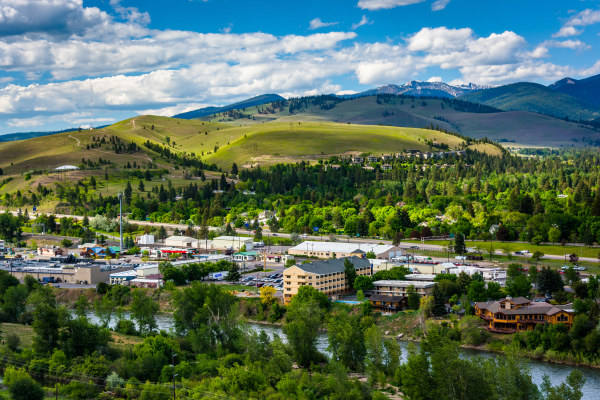 See the best places to live in Missoula
 These are the largest cities in Montana