F
89%
Total crime NAT. AVG.
57%
Violent crime NAT. AVG.
95%
Property crime NAT. AVG.
Date & Last Updated: This data reflects the 2024 calendar year and was released from the FBI in September, 2025; this is the most current data available.
Southeast crime rates are not available from the FBI's UCR (uniform crime reporting) program, as a result, estimates are displayed in the table above. The crime reporting program from the FBI does cover more than 98% of the larger metropolitan areas, which represents more than 309 million U.S. residents. This data is gathered from more than 18,000 law enforcement agencies which include tribal, state, county, college, university and city levels. However, the FBI does not report crime on a neighborhood level, therefore estimates were used to calculate the Southeast crime data. These estimates take into account the overall Columbus crime rates (violent and property), as well as multiple other factors which include: poverty rates, unemployment rates, income, educational achievement, home prices, rent prices and population density. To view crime rates on a block group level, the Southeast crime map below provides a hyper-local overview of all crimes reported throughout Columbus.
StatisticReportedincidentsSoutheast/100k peopleColumbus/100k peopleOhio/100k peopleNational/100k people
Total crime28,2713,995 (estimate)3,0881,8452,119
Murder112n/a12.25.05.0
Rape1,137n/a124.245.737.5
Robbery803n/a87.745.560.6
Assault1,929n/a210.7197.4256.1
Violent crime3,981563 (estimate)435294359
Burglary3,703n/a404.5206.0229.2
Theft15,618n/a1,706.11,132.81,272.1
Vehicle theft4,969n/a542.8212.5258.8
Property crime24,2903,432 (estimate)2,6531,5511,760

Southeast crime map

Get this widget

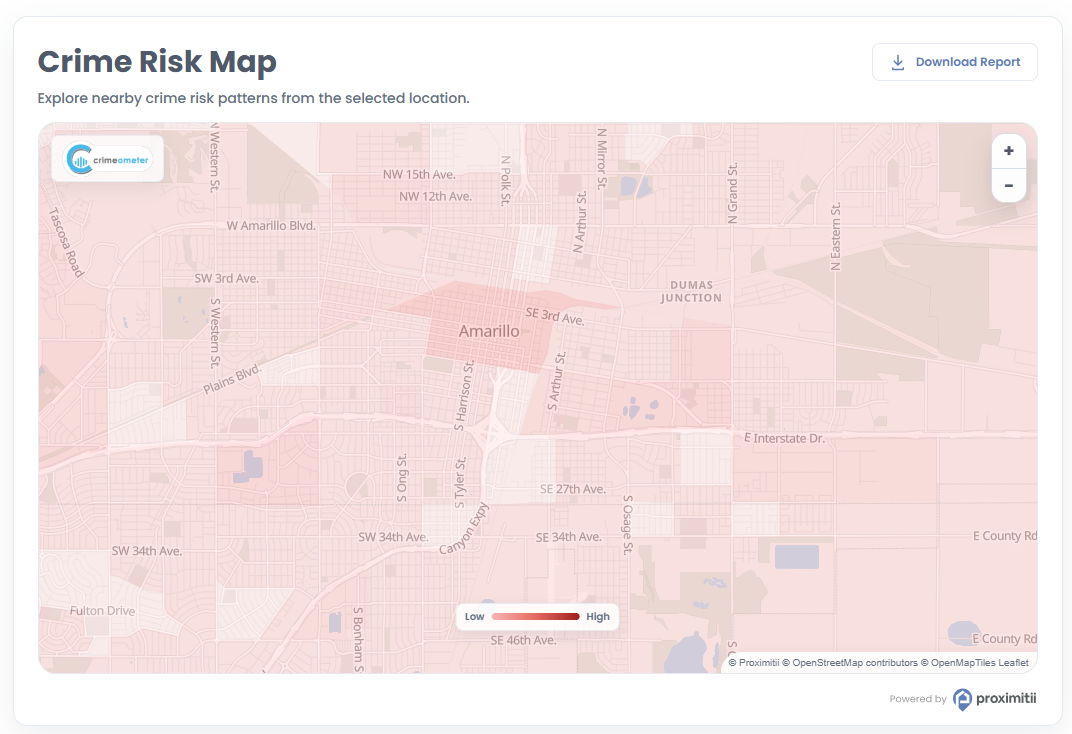
The Southeast crime map by CrimeoMeter provides a detailed overview of all crimes in Southeast as reported by the local law enforcement agencies. Based on the color coded legend above, the crime map outlines the areas with lower crime compared to the areas with higher crime. The Southeast crime heat map offers insight into the total crimes on a block group level. Please note that the red areas on the Southeast crime map does not always indicate that it is a dangerous area for its residents. Areas on the heat map could be inflated if they are located in high traffic areas like airports, sports centers or large parks. Other areas on the heat map could see increased crime rates if they are located in major tourist areas like the downtown core.

Get Crime Data Within A 1-Mile Radius! Local Insights Report
  • View detailed crime data near your address
  • Use local crime insights to avoid risky areas
  • Get hyperlocal crime stats, not city averages
* Crime data not available for every address.
Local Insights Report

Compare Columbus, OH Crime

City Image
    City Default Image
      vs
      Compare Neighborhoods & Addresses Local Insights Report

      Why stop at city-to-city? With Local Insights, you can compare neighborhoods, zip codes, or even exact addresses. Access 300+ hyperlocal data points—from schools and crime to housing and amenities—to see which area is the better fit.

      Local Insights Report

      Crime Quick Facts

      • Southeast crime rates are 89% higher than the national average
      • Violent crimes in Southeast are 57% higher than the national average
      • In Southeast you have a 1 in 26 chance of becoming a victim of crime
      • Southeast is safer than 77% of the cities in Ohio
      • Year over year crime in Columbus has not changed

      Southeast, Columbus, OH Crime Quiz


        Safest Places to Live in and Around Southeast

        See all the best places to live around Southeast
        How would you rate the amount of crime in Southeast?
        Write a review to give others more information about this area.
        Do you feel safe walking alone at night in Southeast?
        Write a review to give others more information about this area.
        See all Southeast poll results

        Daily Crime In Southeast (per 100,000 people)

        How Safe is Southeast (higher is better)

        Chance of Being A Victim of Crime in Southeast

        The chance of being a victim of violent crime in Southeast is 1 in 178
        The chance of being a victim of property crime in Southeast is 1 in 30
        The chance of being a victim of crime in Southeast is 1 in 26

        Year Over Year Crime In Columbus (per 100,000 people)

        Columbus police department

        Item Southeast Columbus Ohio
        Law enforcement employees (officers & civilians)n/a2,13817,044
        Police officers & civilians /1000 residentsn/a2.72.7

        Sex offenders in Ohio

        State Total offenders Ohio /100K National /100K
        Ohio17,872156266
        There are a total of 17,872 sex offenders in Ohio. This yields a total of 156 sex offenders in Ohio per 100,000 residents which is 41% less than the national average.

        Nearby Cities With Low Crime Rates

        City Population Violent crime/100k people Property crime/100k people Total crime/100k people
        Beechwood Trails, OH3,04056295351
        Lithopolis, OH1,99859309368
        Minerva Park, OH1,37262326388
        Commercial Point, OH2,17475396471
        South Bloomfield, OH2,49035490525
        Ashville, OH4,28162497559
        Canal Winchester, OH9,148116612728
        Columbus, OH889,0794352,6533,088

        Cities with similar population

        City Population Violent crime/100k people Property crime/100k people Total crime/100k people
        Fort Worth, TX892,2214582,7003,158
        Jacksonville, FL902,4883161,6821,998
        San Francisco, CA874,7845963,9294,526
        Charlotte, NC873,5707333,7054,439
        Indianapolis, IN869,3878783,3364,214
        Columbus, OH889,0794352,6533,088
        Source: The Southeast, Columbus, OH crime data displayed above is derived from the FBI's uniform crime reports for the year of 2024. The crime report encompasses more than 18,000 city and state law enforcement agencies reporting data on property and violent crimes. The uniform crime reports program represents approximately 309 million American residents, which results in 98% coverage of metropolitan statistical areas.