
| Statistic | Reportedincidents | /100k people | Clarksville/100k people | Texas/100k people | National/100k people |
| Total crime | 5 | n/a (estimate) | 173 | 2,430 | 2,119 |
| Murder | 0 | n/a | 0.0 | 5.2 | 5.0 |
| Rape | 0 | n/a | 0.0 | 50.0 | 37.5 |
| Robbery | 0 | n/a | 0.0 | 63.5 | 60.6 |
| Assault | 1 | n/a | 34.7 | 270.7 | 256.1 |
| Violent crime | 1 | n/a (estimate) | 35 | 389 | 359 |
| Burglary | 2 | n/a | 69.3 | 284.3 | 229.2 |
| Theft | 2 | n/a | 69.3 | 1,425.6 | 1,272.1 |
| Vehicle theft | 0 | n/a | 0.0 | 330.7 | 258.8 |
| Property crime | 4 | n/a (estimate) | 139 | 2,041 | 1,760 |
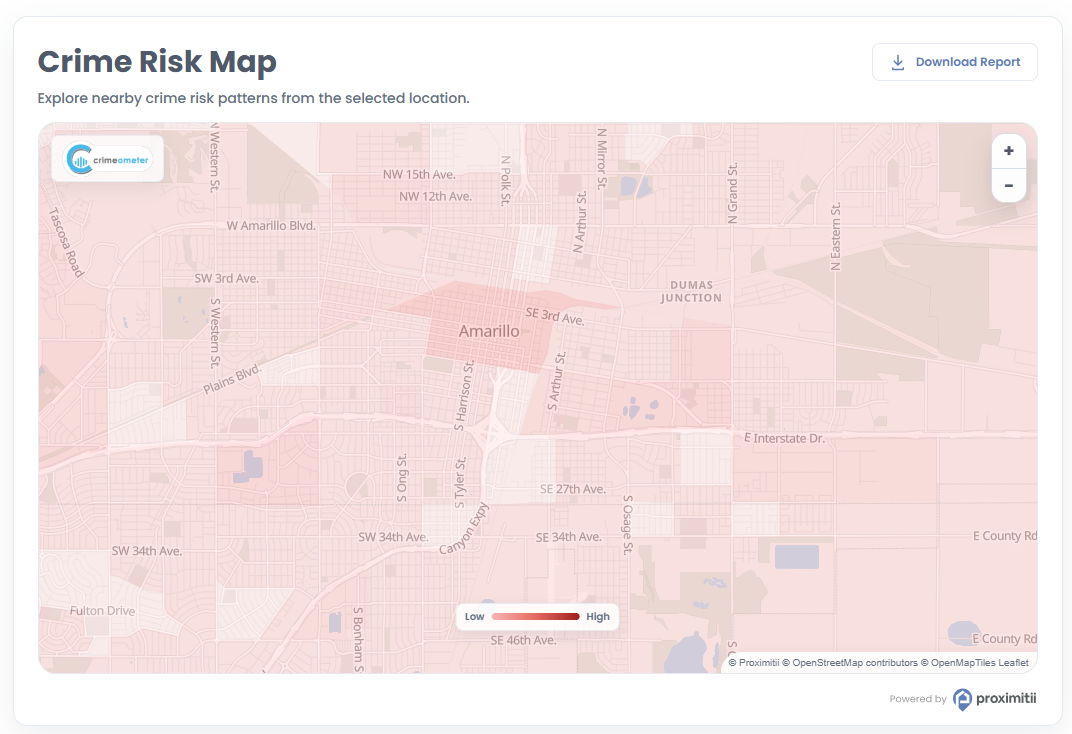

Crime can be categorized into two primary types: violent and property crimes. Violent crimes encompass offenses such as murder, rape, robbery, and assault, whereas property crimes involve acts like burglary, theft, and vehicle theft. The overall crime rate in Clarksville is 91.8% lower than the national average. Specifically, there were 1 violent crimes reported in Clarksville, equivalent to 35 per 100,000 residents, which is lower than the national average by 90.4%. Additionally, Clarksville recorded 4 property crimes, amounting to 139 per 100,000 people, lower than the national average by 92.1%.
Boasting a crime rate of 173, well below the national average of 2119, Clarksville emerges as a standout destination for those seeking a secure place to reside in the United States. This crime rate is derived from the total occurrences of both violent and property crimes per 100,000 residents, underscoring the unwavering dedication of Clarksville to ensure a safe living environment for its residents.
Clarksville distinguishes itself with one of the lowest violent crime rates in the U.S., reporting a mere 35 violent crimes per 100,000 people. This achievement firmly establishes Clarksville among the safest cities in the nation, rendering it an alluring choice for those seeking a new place to call home.
Clarksville showcased a dedication to violent crime safety in its latest reported crime year by achieving a murder rate of 0. This accomplishment could indicate that it is a safe place for residents, but also provides a shining example to other urban areas endeavoring to create safer communities.
The property crime rates per 100,000 individuals have shown a steady decrease of more than 50% since 1990, with a slight uptick in recent years. The most recent crime data reveals that Clarksville records a property crime rate of 139 incidents per 100,000 people, significantly lower than the national average of 1760. This underscores Clarksville as an exceptionally secure and attractive residential destination, highlighting its unwavering dedication to fostering safety and community well-being.
The United States contends with some of the world's highest vehicle theft rates, with approximately 300 vehicle thefts per 100,000 individuals. Remarkably, only a modest fraction, approximately 10%, of cities have been fortunate enough to have zero reported instances of stolen vehicles. Clarksville stands out as one of these cities, as it reported no vehicle thefts in the most recent crime report, underscoring its commitment to a secure environment.
Determining whether Clarksville is a place to live may not always yield a simple answer, given the city's varying safety levels across different areas. Nonetheless, comprehending the city's overall crime rate can be a valuable asset. In broad terms, Clarksville has an overall crime rate that is 92% lower than the national average. When we take a look at crime on a daily basis, this translates into 0.01 daily occurrences, comprising 0 violent crimes and 0.01 property crimes. Scrutinizing these statistics provides a foundation for a more informed assessment of the suitability of Clarksville as a potential place to establish residency.
Year-over-year crime data allows residents and potential residents to assess the crime in Clarksville. A decrease in crime rates may indicate improving safety, while an increase could raise concerns. The year-over-year crime rate in Clarksville has decreased by 72.2%. Violent crimes have decreased by 50%, while property crimes have decreased by 75%. By comparing crime rates from one year to the next, authorities and communities can identify trends and patterns in criminal activity. This helps in understanding whether crime is increasing, decreasing, or remaining stable over time.
The economic prosperity of a city's inhabitants exerts substantial influence on crime stats. Elevated poverty rates and income inequality can precipitate heightened criminal activity, as individuals may turn to illicit means to fulfill their fundamental requirements. While lower poverty rates could lead to lower Clarksville crime rates. In Clarksville, the poverty rate stands at 27.6%, diverging from the national average of 15.1%.
In Clarksville, the ratio of police officers and civilians stands at 3.65 per 1,000 residents, contrasting with the national average of 3.25. This discrepancy highlights the potential impact of law enforcement and community policing on crime rates. The strength of their collaboration can serve as a deterrent to criminal behavior, fostering a safer environment. Effective law enforcement leans heavily on community policing strategies that prioritize the cultivation of trust and cooperation between police and residents. It's essential to recognize that the effectiveness of these efforts isn't solely tied to the quantity of officers but also hinges on the quality of their engagement with the community.
In Clarksville, the median home price stands at $65,269, diverging from the national average of $326,622. Elevated housing costs often induce financial strain among residents. When individuals grapple with the challenges of affording housing, they may find themselves compelled to resort to criminal activities as a means of addressing their financial hardships, including acts like theft or fraud. This predicament is particularly pronounced in areas where housing affordability poses a persistent issue, giving rise to heightened concerns regarding crime. In such instances, some individuals and families may find themselves constrained to reside in cramped or subpar housing conditions, exacerbating stress levels and potentially fostering domestic disputes and associated criminal incidents.

| Item | Clarksville | Texas | National |
| Law enforcement employees (officers & civilians) | 12 | 46,020 | 558,732 |
| Police officers & civilians /1000 residents | 3.7 | 3.0 | 3.3 |
| State | Total offenders | Texas /100K | National /100K |
| Texas | 95,281 | 443 | 266 |
| City | Population | Violent crime/100k people | Property crime/100k people | Total crime/100k people |
| Bogata, TX | 1,216 | 0 | 0 | 0 |
| Detroit, TX | 870 | 555 | 2,912 | 3,467 |
| Deport, TX | 835 | 559 | 2,933 | 3,493 |
| Clarksville, TX | 3,222 | 35 | 139 | 173 |
| City | Population | Violent crime/100k people | Property crime/100k people | Total crime/100k people |
| Brackenridge, PA | 3,221 | 164 | 956 | 1,120 |
| Buffalo, MO | 3,224 | 297 | 1,250 | 1,547 |
| Checotah, OK | 3,219 | 193 | 1,707 | 1,901 |
| Corydon, IN | 3,225 | 163 | 719 | 882 |
| Kachina Village, AZ | 3,226 | 82 | 350 | 432 |
| Clarksville, TX | 3,222 | 35 | 139 | 173 |

 Here are the best places to live in Texas
 See the best places to live in Clarksville
 Most Dangerous Cities In The US
 Check out the 10 safest cities in Texas