
| Statistic | Reportedincidents | /100k people | Chicago Heights/100k people | Illinois/100k people | National/100k people |
| Total crime | 1,023 | n/a (estimate) | 3,965 | 2,004 | 2,119 |
| Murder | 5 | n/a | 19.4 | 5.8 | 5.0 |
| Rape | 12 | n/a | 46.5 | 46.9 | 37.5 |
| Robbery | 68 | n/a | 263.5 | 90.2 | 60.6 |
| Assault | 233 | n/a | 903.0 | 146.3 | 256.1 |
| Violent crime | 318 | n/a (estimate) | 1,232 | 289 | 359 |
| Burglary | 174 | n/a | 674.4 | 290.5 | 229.2 |
| Theft | 378 | n/a | 1,465.0 | 1,134.4 | 1,272.1 |
| Vehicle theft | 153 | n/a | 593.0 | 290.4 | 258.8 |
| Property crime | 705 | n/a (estimate) | 2,732 | 1,715 | 1,760 |
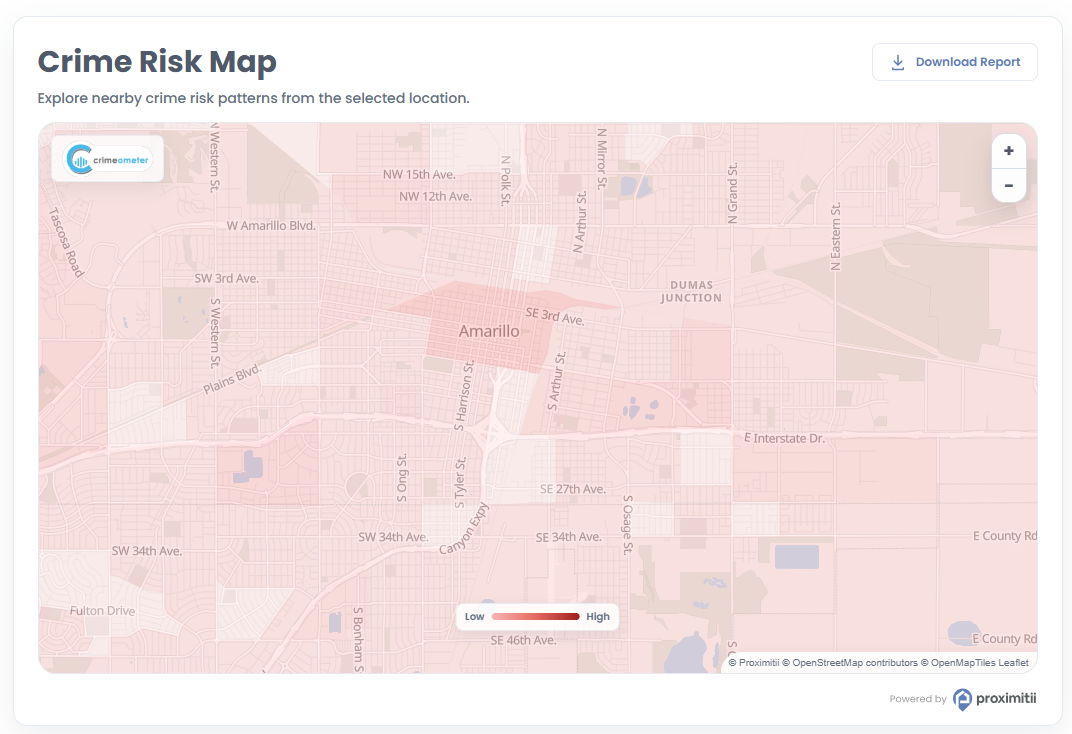
Crime is typically categorized into two main types: violent and property crimes. Violent crimes encompass offenses such as murder, rape, robbery, and assault, while property crimes include burglary, theft, and vehicle theft. Based on the most recent report, the Chicago Heights crime rate is higher than the national average by 87.1%. Specifically, there were 318 violent crimes in Chicago Heights, equivalent to 1232 per 100,000 individuals, higher than the national average by 243.2%. Furthermore, Chicago Heights recorded 705 property crimes, amounting to 2732 per 100,000 residents, which was higher than the average by 55.2%.
Chicago Heights has gained notoriety as one of the most dangerous cities in the United States, given its alarming violent crime rate of 1232 crimes per 100,000 people. In fact, Chicago Heights falls within the lowest 10% among cities reporting violent crimes last year, resulting in a concerning 1 in 82 likelihood of experiencing a violent crime. It's important to note that safety levels may vary across different areas within the city, and this statistic doesn't necessarily reflect the entire city's situation regarding violent crime.
While murder rates in the United States have generally declined since 1990, recent years have seen an unfortunate uptick. Chicago Heights stands out with one of the nation's highest murder rates among cities reporting crime data. In Chicago Heights, a total of 5 murders were reported, equating to 19 murders per 100,000 residents. This statistic underscores the challenges facing the area in terms of severe violent crime and the importance of ongoing efforts to enhance safety and security within the community.
The occurrence of vehicle thefts has been increasing nationwide, and Chicago Heights faces one of the highest vehicle theft rates in the United States. In the latest reported crime year, there were a reported 153 vehicle thefts, translating to 593 stolen vehicles per 100,000 residents. This places Chicago Heights in the bottom 10% among all cities, signifying that 90% of cities have less stolen vehicles. The likelihood of experiencing a vehicle theft is 1 in 169.
What is the prevailing sentiment among Chicago Heights residents regarding the state of crime? A comprehensive survey conducted by AreaVibes, involving 17 respondents, sheds light on this matter. The results were as follows: 24% of Chicago Heights residents expressed a notable sense of security, asserting that crime was virtually non-existent in their community, and they felt at ease strolling the streets after dark. While, 76% of those surveyed held a contrasting viewpoint, perceiving a higher incidence of crime, leading them to feel apprehensive about walking alone at night.
To get a feel for the safety of living in Chicago Heights, it's essential to analyze both the overall crime rate and the daily incident count. Chicago Heights presents a total crime rate that is 87% higher than the national average per 100,000 residents. Consequently, Chicago Heights experiences an average of 2.8 daily crimes, comprising 0.87 violent incidents and 1.93 property-related offenses. This evaluation offers a comprehensive understanding of the safety landscape, aiding individuals in making informed decisions when considering relocation.
Examining year-over-year crime data provides insights into short-term trends with regards to the crime activity in Chicago Heights. This analysis involves comparing crime rates from one year to the next, enabling the identification of patterns and fluctuations in crime. Such information proves invaluable to residents seeking to make well-informed decisions about their choice of residence. In the most recent year, compared to the previous one, total crime in Chicago Heights has increased by 27.2%. Specifically, violent crime has increased by 39.5%, while property crime has increased by 22.4%. This data empowers individuals with a clearer understanding of the evolving safety landscape in Chicago Heights.
Highly populated regions typically encompass expansive urban hubs teeming with diverse economic prospects. Within these areas, income inequality can be exacerbated, giving rise to enclaves of poverty amid affluence. Communities marked by economic disparities may contend with heightened property crimes, and in certain instances, violent crimes. Conversely, regions characterized by low population density often exhibit lower Chicago Heights crime rates. For instance, in Chicago Heights, the population density stands at 2996 people per square mile, diverging from the national average of 90.6 people per square mile.
Rising cost of living expenses, including increased housing costs, grocery, utility and healthcare expenditures, can induce financial strain on individuals and families, particularly those with limited financial resources. Such economic stress may propel individuals towards crime, including theft or burglary, as a means of addressing their financial hardships. Conversely, cities characterized by a lower cost of living may alleviate economic pressures, potentially resulting in a reduced crime rate. In Chicago Heights, the cost of living is 10.64% lower than the national average, reflecting a more affordable economic environment that could contribute to a decrease in crime levels.
In cities grappling with housing affordability challenges, crime can emerge as a prominent issue. Certain individuals and families may find themselves needing to reside in cramped or subpar housing conditions, elevating stress levels and potentially fueling domestic conflicts and associated criminal incidents. Chicago Heights has a median home price of $195,538, deviating from the national average of $326,622. Large disparities in housing costs can significantly impact the well-being of residents and the prevalence of crime within the community.

| Item | Chicago Heights | Illinois | National |
| Law enforcement employees (officers & civilians) | 103 | 30,690 | 558,732 |
| Police officers & civilians /1000 residents | n/a | 2.6 | 3.3 |
| State | Total offenders | Illinois /100K | National /100K |
| Illinois | 32,213 | 263 | 266 |
| City | Population | Violent crime/100k people | Property crime/100k people | Total crime/100k people |
| St. John, IN | 18,872 | 24 | 129 | 153 |
| Lowell, IN | 10,146 | 26 | 201 | 228 |
| Lake Dalecarlia, IN | 1,847 | 44 | 194 | 237 |
| Cedar Lake, IN | 13,302 | 66 | 263 | 328 |
| Dyer, IN | 16,417 | 12 | 344 | 356 |
| Beecher, IL | 4,532 | 43 | 385 | 427 |
| Peotone, IL | 4,162 | 71 | 357 | 429 |
| Chicago Heights, IL | 30,540 | 1,232 | 2,732 | 3,965 |
| City | Population | Violent crime/100k people | Property crime/100k people | Total crime/100k people |
| Suisun City, CA | 30,544 | 389 | 1,477 | 1,867 |
| Parkersburg, WV | 30,536 | 260 | 3,217 | 3,477 |
| Walnut, CA | 30,544 | 127 | 1,891 | 2,019 |
| East Palo Alto, CA | 30,529 | 607 | 1,920 | 2,527 |
| Highland Park, IL | 30,564 | 49 | 812 | 861 |
| Chicago Heights, IL | 30,540 | 1,232 | 2,732 | 3,965 |

 Here are the best places to live in Illinois
 See the best places to live in Chicago Heights
 Safest States In The US
 These are the 10 cheapest cities in Illinois