
| Statistic | Reportedincidents | /100k people | Cameron/100k people | Texas/100k people | National/100k people |
| Total crime | 64 | n/a (estimate) | 1,147 | 2,430 | 2,119 |
| Murder | 0 | n/a | 0.0 | 5.2 | 5.0 |
| Rape | 2 | n/a | 35.8 | 50.0 | 37.5 |
| Robbery | 0 | n/a | 0.0 | 63.5 | 60.6 |
| Assault | 11 | n/a | 197.2 | 270.7 | 256.1 |
| Violent crime | 13 | n/a (estimate) | 233 | 389 | 359 |
| Burglary | 28 | n/a | 501.9 | 284.3 | 229.2 |
| Theft | 12 | n/a | 215.1 | 1,425.6 | 1,272.1 |
| Vehicle theft | 11 | n/a | 197.2 | 330.7 | 258.8 |
| Property crime | 51 | n/a (estimate) | 914 | 2,041 | 1,760 |
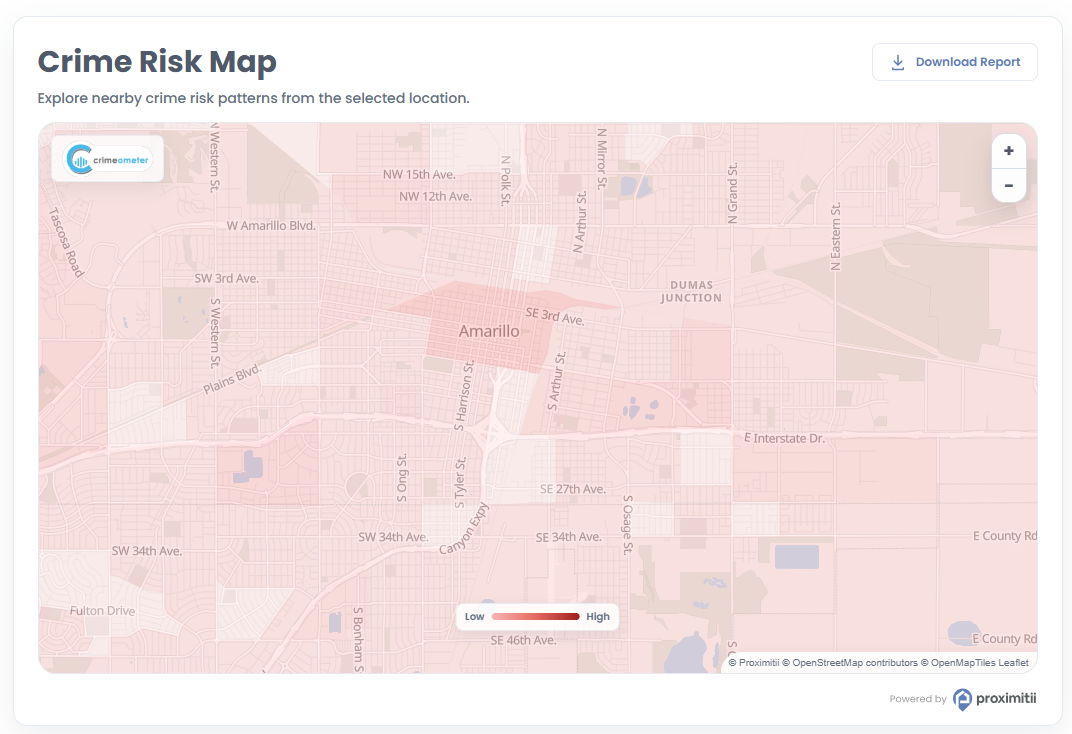

Looking at the most recent crime report, the crime rate in Cameron is 45.9% lower than the national average. These crimes fall into two primary categories: violent and property. Violent crimes encompass murder, rape, robbery and assault, while property crimes involve theft, vehicle theft and burglary. In Cameron, there were 13 reported violent crimes, equivalent to 233 per 100,000 individuals, 35.1% lower than the national average. Additionally, there were 51 property crimes, amounting to 914 per 100,000 residents, 48.1% lower than the U.S. average.
In the latest reported crime year, Cameron recorded zero homicides. This statistic potentially positions the city as a paragon of security, radiating a profound sense of safety for its residents. A low number of severe violent crimes instills a deep feeling of well-being among its community but also establishes a lofty benchmark for other locales aspiring to foster equally secure environments.
To get a feel for the safety of living in Cameron, it's essential to analyze both the overall crime rate and the daily incident count. Cameron presents a total crime rate that is 46% lower than the national average per 100,000 residents. Consequently, Cameron experiences an average of 0.18 daily crimes, comprising 0.04 violent incidents and 0.14 property-related offenses. This evaluation offers a comprehensive understanding of the safety landscape, aiding individuals in making informed decisions when considering relocation.
Year-over-year crime data allows residents and potential residents to assess the crime in Cameron. A decrease in crime rates may indicate improving safety, while an increase could raise concerns. The year-over-year crime rate in Cameron has increased by 20.8%. Violent crimes have increased by 44.4%, while property crimes have increased by 15.9%. By comparing crime rates from one year to the next, authorities and communities can identify trends and patterns in criminal activity. This helps in understanding whether crime is increasing, decreasing, or remaining stable over time.
Regions characterized by high population density frequently encompass expansive urban hubs that offer diverse economic prospects. In such areas, income inequality can be exacerbated, creating pockets of poverty alongside affluence. Economic disparities within these regions may correlate with elevated property crimes and, in certain instances, violent crimes. Conversely, areas with low population density numbers generally exhibit reduced Cameron crime rates. Cameron registers a population density of 1068.6 people per square mile, in contrast to the national average of 90.6 people per square mile.
In Cameron, the cost of living is 21.16% lower than the national average. A high cost of living can induce economic stress for locals, especially those with limited financial resources. When people grapple with soaring housing expenses, utility bills, healthcare costs, and other essential necessities, they may be driven towards criminal activities, including theft or fraud, as a means of financial survival. Conversely, cities boasting a lower cost of living may mitigate economic pressures and potentially result in reduced crime rates.
The impact of law enforcement and community policing efforts plays a crucial role in shaping crime rates in any city. A robust and cooperative bond between law enforcement and the community can serve as a deterrent to criminal activities, enhancing overall safety. In Cameron, the ratio of police officers and civilians per 1,000 residents stands at 2.49, differing from the national average of 3.25. Effective law enforcement hinges not solely on officer numbers but also on the manner in which they interact and collaborate with the community. Building trust and cooperation are central tenets of community policing, amplifying its influence on crime prevention.

| Item | Cameron | Texas | National |
| Law enforcement employees (officers & civilians) | 14 | 46,020 | 558,732 |
| Police officers & civilians /1000 residents | 2.5 | 3.0 | 3.3 |
| State | Total offenders | Texas /100K | National /100K |
| Texas | 95,281 | 443 | 266 |
| City | Population | Violent crime/100k people | Property crime/100k people | Total crime/100k people |
| Rosebud, TX | 1,460 | 0 | 0 | 0 |
| Rogers, TX | 1,434 | 188 | 988 | 1,176 |
| Rockdale, TX | 5,714 | 810 | 987 | 1,797 |
| Milano, TX | 658 | 467 | 2,450 | 2,917 |
| Buckholts, TX | 490 | 613 | 3,216 | 3,830 |
| Cameron, TX | 5,589 | 233 | 914 | 1,147 |
| City | Population | Violent crime/100k people | Property crime/100k people | Total crime/100k people |
| Sandersville, GA | 5,590 | 346 | 1,777 | 2,123 |
| Tice, FL | 5,590 | 299 | 1,591 | 1,890 |
| Salamanca, NY | 5,591 | 384 | 1,395 | 1,779 |
| Sayre, PA | 5,591 | 186 | 403 | 590 |
| Preston, ID | 5,587 | 64 | 382 | 446 |
| Cameron, TX | 5,589 | 233 | 914 | 1,147 |

 Here are the best places to live in Texas
 See the best places to live in Cameron
 Safest Cities In The US
 Most Dangerous Cities In The US